


Page 17 - AA 2023 Year Book Website
P. 17
Editorial


          network compared to the rest of the mid-  measures to increase local production.   Middle East Poultry Meat
          dle eastern countries. The year-on-year   For instance, as  part  of its Saudi Vision   Market News
          poultry meat import has constantly been   2030, the Saudi Ministry of Environment,
          rising in the country to support growing   Water and Agriculture (MEWA) encour-  • October  2022: Saudi Arabia’s Ha-
          poultry meat demand.               ages local  producers to  increase  pro-  lal Products Development  Company
                                             duction drastically. MEWA expects local   (HPDC) and global meat producer
           •  For instance, according to the Unit-  production to account for 80% by 2025   BRF  announced signing a joint  venture
          ed States  Department of Agriculture   and 100% by 2030. To achieve this, the   agreement (JVA).  The agreement aims
          (USDA), data for major exporting coun-  ministry is offering various incentives to   to establish a JV company in Saudi Ara-
          tries for Jan-May 2021 reflect that Saudi   local chicken meat producers, including   bia to increase the production capacity
          Arabia imported 304,564 MT of chicken   up to USD 187 million annually as a direct   along the poultry sector value chain and
          meat, an increase of 34% over 2020. Fur-  production-based subsidiary.  contribute  to  localizing halal  product
          thermore, Saudi Arabia’s poultry market                                manufacturing capabilities.
          is flourishing and providing various op-  Middle East Poultry Meat
          portunities for potential market entrants   Industry Overview            • July 2022: BRF Sadia inaugurated its
          due to the heavy poultry meat consump-                                 new plant, ‘Al Joody,’ in Dammam, Saudi
          tion by the heavily concentrated Muslim   The Middle East poultry meat market is   Arabia, which helps increase its month-
          population in the country and beyond.  highly competitive, with cut-throat com-  ly production capacity  to 1,200 tons of
                                             petition among the market players to in-  food.  This development  is expected to
           • Moreover, factors such as affordabil-  crease their share in the studied market.   play  an integral  role in the growth  and
          ity and the perception that poultry meat   The major players in this market are Al   development  of the poultry industry in
          is healthier than red meat also signifi-  Kabeer Group ME, Al-Watania Poultry,   Saudi Arabia.
          cantly contribute to market growth. Con-  Almarai Food Company, BRF S.A., and
          sumers  in Saudi Arabia hugely prefer   Tanmiah Food Company.            • February 2022: BRF Global achieved
          locally produced fresh chicken meat and                                the ISO 37001 Anti-bribery Management
          can even pay 50% more for fresh/chilled   Moreover,  the  market depicts  a  wide   System certification, issued by an inde-
          domestic  chicken  meat over  frozen  im-  presence of unorganized butchers and   pendent  and non-governmental entity
          ported chicken meat.               meat shops catering to the market do-  based in Switzerland. The certification is
                                             mestically. To widen their scope of opera-  internationally  recognized and  empha-
           • Saudi  Arabia  has a significant do-  tions and expand business opportunities,   sizes that the company meets technical
          mestic poultry meat production capac-  leading meat manufacturers are expand-  requirements and has effective policies,
          ity. However, presently, the  country is   ing their meat business in the region by   procedures, and controls to prevent and
          not self-sufficient in the poultry sector.   increasing their production units and   combat bribery, thus promoting an ethi-
          Hence, the government  of Saudi Ara-  launching their new product lines, in-  cal and healthy environment.
          bia is focusing on establishing strategic   tending to gain a competitive advantage.


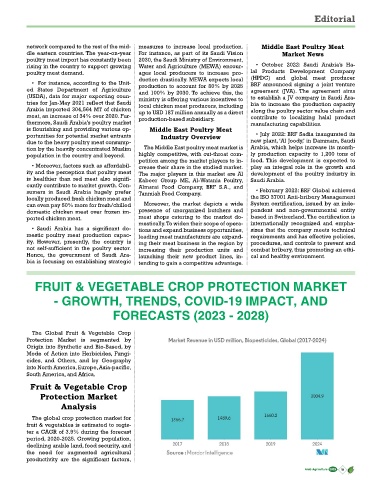
            FRUIT & VEGETABLE CROP PROTECTION MARKET
                  - GROWTH, TRENDS, COVID-19 IMPACT, AND

                                     FORECASTS (2023 - 2028)


           The Global  Fruit  &  Vegetable Crop
          Protection Market  is  segmented by
          Origin into Synthetic and Bio-Based, by
          Mode  of Action  into Herbicides, Fungi-
          cides, and Others, and by Geography
          into North America, Europe, Asia-pacific,
          South America, and Africa.
           Fruit & Vegetable Crop
              Protection Market
                     Analysis

           The global crop protection market for
          fruit & vegetables is estimated to regis-
          ter a CAGR of 3.9% during the forecast
          period, 2020-2025. Growing population,
          declining arable land, food security, and
          the need  for augmented agricultural
          productivity  are  the significant  factors,
                                                                                                  Arab Agriculture  2023  15

