


Page 13 - AA 2023 Year Book Website
P. 13
Editorial


          ply juveniles  to other  projects. Com-  companies. As mentioned, currently the
          panies currently growing  Yellowtail   only commercial hatchery is in Chile.
          kingfish have their own broodstock  or   The company sells larvae and juveniles
          imported juveniles from Chile (the only   around  the world  with no other  com-
          commercial  hatchery supplying juve-  mercial supplier to compete with. Yel-
          niles around the year) at great cost.  lowtail kingfish juveniles (1 gr) are being
          Markets                            sold for $3.14 per individual (ACUINOR,
                                             Chile, 2018).
          Market development                   Sale of juveniles (reaching 1-5gr in 30-
           While Seriola sp. and specifically Yel-  40 days) or even larvae (24 hours after
          lowtail kingfish are known locally in the   hatching) to established hatcheries and
          Gulf and in other major markets (i.e. Eu-  grow-out companies represents the fast-
          rope, USA), it is not a main seafood spe-  est ROI.                         Cultured Yellowtail Kingfish
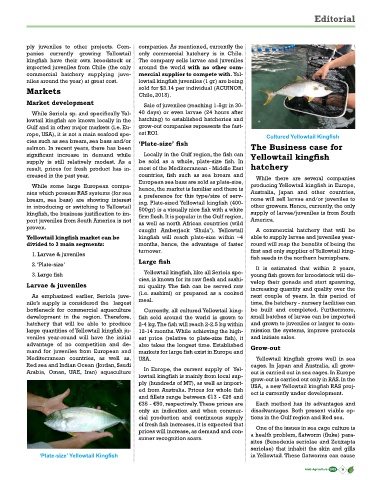
          cies such as sea bream, sea bass and/or   ‘Plate-size’ fish
          salmon. In recent years, there has been                                The Business case for
          significant increase  in demand  while   Locally in the Gulf region, the fish can   Yellowtail kingfish
          supply is still  relatively modest. As a   be sold as a whole, plate-size fish. In
          result, prices for fresh product has in-  most of the Mediterranean - Middle East  hatchery
          creased in the past year.          countries,  fish such as  sea  bream and   While  there  are  several companies
                                             European sea bass are sold as plate-size,
           While some large European compa-  hence, the market is familiar and there is   producing Yellowtail kingfish in Europe,
          nies which possess RAS systems (for sea   a preference  for this type/size of serv-  Australia, Japan and other  countries,
          bream, sea bass) are  showing  interest   ing. Plate-sized Yellowtail kingfish (400-  none will sell larvae and/or juveniles to
          in introducing or switching to Yellowtail   500gr) is a visually nice fish with a white   other growers. Hence, currently, the only
          kingfish, the business justification to im-  firm flesh. It is popular in the Gulf region,   supply of larvae/juveniles is from South
          port juveniles from South America is not   as well as north African countries (wild   America.
          proven.                            caught  Amberjack  ‘Shula’). Yellowtail   A commercial  hatchery that  will  be
          Yellowtail kingfish market can be   kingfish will reach plate-size within ~4   able to supply larvae and juveniles year-
          divided to 3 main segments:        months,  hence,  the advantage of faster   round will reap the benefits of being the
                                             turnover.                           first and only supplier of Yellowtail king-
           1. Larvae & juveniles                                                 fish seeds in the northern hemisphere.
                                             Large fish
           2. ‘Plate-size’                                                         It is estimated that within  2 years,
           3. Large fish                       Yellowtail kingfish, like all Seriola spe-  young fish grown for broodstock will de-
                                             cies, is known for its raw flesh and sashi-  velop their gonads and start spawning,
          Larvae & juveniles                 mi quality.  The fish can  be served raw   increasing quantity and quality over the
                                             (i.e. sashimi) or prepared as a cooked
           As emphasized earlier, Seriola juve-                                  next  couple of years. In this period of
          nile’s supply is considered the  largest   meal.                       time, the hatchery - nursery facilities can
          bottleneck  for  commercial aquaculture   Currently, all cultured Yellowtail king-  be built and completed. Furthermore,
          development in  the region.  Therefore,   fish sold around the world is grown to   small batches of larvae can be imported
          hatchery that  will be able to produce   2-4 kg. The fish will reach 2-2.5 kg within   and grown to juveniles or larger to com-
          large quantities of Yellowtail kingfish ju-  12-14 months. While achieving the high-  mission  the systems, improve protocols
          veniles  year-round  will have  the  initial   est price (relative to plate-size fish), it   and initiate sales.
          advantage  of no  competition  and de-  also takes the longest time. Established   Grow-out
          mand for  juveniles  from  European  and   markets for large fish exist in Europe and
          Mediterranean countries, as  well as,   USA.                             Yellowtail kingfish grows well  in  sea
          Red sea and Indian Ocean (Jordan, Saudi                                cages. In Japan and Australia, all  grow-
          Arabia, Oman, UAE, Iran) aquaculture   In Europe, the current supply of  Yel-  out is carried out in sea cages. In Europe
                                             lowtail kingfish is mainly from local sup-  grow-out is carried out only in RAS. In the
                                             ply (hundreds of MT), as well as import-  USA,  a new Yellowtail kingfish RAS proj-
                                             ed from Australia. Prices for whole  fish   ect is currently under development.
                                             and fillets range between €13 - €26 and
                                             €35 - €50, respectively. These prices are   Each method has its  advantages and
                                             only an indication  and when  commer-  disadvantages.  Both present viable op-
                                             cial production and continuous supply   tions in the Gulf region and Red sea.
                                             of fresh fish increases, it is expected that
                                             prices will increase, as demand and con-  One of the issues in sea cage culture is
                                             sumer recognition soars.            a health problem, flatworm (fluke) para-
                                                                                 sites (Benedenia seriolae and Zeuxapta
                                                                                 seriolae) that inhabit the  skin  and gills
              ‘Plate-size’ Yellowtail Kingfish                                   in Yellowtail. These flatworms can cause

                                                                                                  Arab Agriculture  2023  11

