


Page 15 - Vol.39-No.5
P. 15
CROP PROTECTION


                                              Keeping a few animals whether free  full fruits of your labours is sometimes nigh
                                            range chickens and ducks, rabbits, goats  on impossible.
                                            or swine can be start of much bigger things   Some crops like banana, cassava, mango
                                            to come,  graduating to more and more   and citrus will generally withstand most
                                            intensively reared chickens and ducks   pests and disease problems while vege-
                                            giving enough meat and eggs for home   table crops such as tomato, cucumber and
                                            consumption and sale at the local market.   sweet pepper succumb to a wide range
                                            Ducks do not have to be provided with a   of insect pests and fungal diseases that
                                            pond but best results will be obtained if   lurk in the tropics. But householders can
                                            there is sufficient water for ducks to ‘duck’   meet the problem half way using natural
                                            their heads under water thus keeping eyes   insecticides like neem and natural pyrethrin
                                            free from infection.                (both derived from African plants) and rel-
                                            Lessons from the backyard           atively safe inorganic copper compounds
                                                                                like cuprous oxide, cupric hydroxide, copper
                                              There are many lessons to be learned  oxychloride and Bordeaux Mixture (cop-
                                            from the backyard. Trees provide a good  per sulphate) that control most fungal and
                                            lesson to life. Trees that do not bear fruit  bacterial pathogens when used as sprays.
                                            are generally left alone while those which
                                            bear heavy crops of fruit every year are
                                            ones to be bashed, thrashed, beaten and
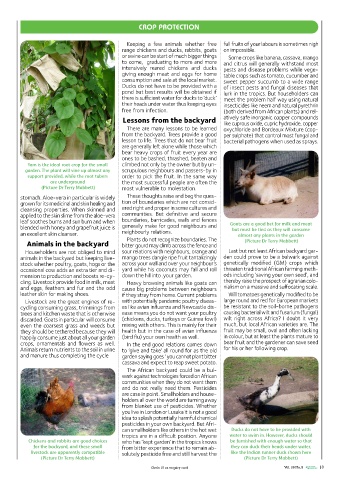
           Yam is the ideal root crop for the small   climbed not only by the owner but by un-
          garden. The plant will vine up almost any   scrupulous neighbours and passers-by in
           support provided, while the root tubers   order to pick the fruit. In the same way
                   are underground          the most successful people are often the
                (Picture Dr Terry Mabbett)  most vulnerable to molestation.

        stomach. Aloe-vera in particular is widely   These thoughts raise and beg the ques-
        grown for its medicinal and skin healing and   tion of boundaries which are not consid-
        cleansing properties. When skinned and   ered right and proper in some cultures and
        applied to the skin slime from the aloe-vera   communities. But definitive and secure
        leaf soothes burns and sun burn and when   boundaries, barricades, walls and fences   Goats are a good bet for milk and meat
        blended with honey and grapefruit juice is   generally make for good neighbours and   but must be tied as they will consume
        an excellent skin cleanser.         neighbourly relations.                   almost any plants in the garden
                                              Plants do not recognize boundaries. The
          Animals in the backyard           bitter gourd may climb across the fence and    (Picture Dr Terry Mabbett)
          Householders are not obliged to mind  sour relations with neighbours, orange and   Last but not least African backyard gar-
        animals in the backyard but keeping live-  mango trees dangle ripe fruit tantalizingly  den could prove to be a bulwark against
        stock whether poultry, goats, hogs or the  across your wall and over your neighbour’s  genetically modified (GM) crops which
        occasional cow adds an extra tier and di-  yard while his coconuts may fall and roll  threaten traditional African farming meth-
        mension to production and boosts re-cy-  down the hill into .your garden.  ods including ‘saving your own seed’, and
        cling. Livestock provide food in milk, meat   Heavy browsing animals like goats can   thereby raise the prospect of agrarian colo-
        and eggs, feathers and fur and the odd  cause big problems between neighbours   nialism on a massive and suffocating scale.
        leather skin for making shoes.      if they stray from home. Current problems   Will tomatoes genetically modified to be
          Livestock are the great engines of re-  with potentially pandemic poultry diseas-  large round and red for European markets
        cycling consuming grass, trimmings from  es like avian influenza and Newcastle dis-  be resistant to the soil-borne pathogens
        trees and kitchen waste that is otherwise  ease means you do not want your poultry  causing bacterial wilt and fusarium (fungal)
        discarded. Goats in particular will consume  (chickens, ducks, turkeys or Guinea fowl)  wilt right across Africa? I doubt it very
        even the coarsest grass and weeds but  mixing with others. This is mainly for their  much, but local African varieties are. The
        they should be tethered because they will  health but in the case of avian influenza  fruit may be small, oval and often lacking
        happily consume just about all your garden  (bird flu) your own health as well.  in colour, but at least the plants mature to
        crops, ornamentals and flowers as well.   In the end good relations comes down   bear fruit and the gardener can save seed
        Animals return nutrients to the soil in urine  to ‘give and take’ all round for as the old   for his or her following crop.
        and manure thus completing the cycle  garden saying goes ‘ you cannot plant bitter
                                            cassava and expect to reap sweet potato.
                                              The African backyard could be a bul-
                                            wark against technologies forced on African
                                            communities when they do not want them
                                            and do not really need them. Pesticides
                                            are case in point. Smallholders and house-
                                            holders all over the world are turning away
                                            from blanket use of pesticides. Whether
                                            you live in London or Lusaka it is not a good
                                            idea to splash potentially harmful chemical
                                            pesticides in your own backyard. But Afri-
                                            can smallholders like others in the hot wet   Ducks do not have to be provided with
                                            tropics are in a difficult position. Anyone   water to swim in. However, ducks should
           Chickens and rabbits are good choices   who has ‘kept garden’ in the tropics knows   be furnished with enough water so that
             for the backyard, and these small   from bitter experience that to remain ab-  they can duck their heads under water,
            livestock are apparently compatible   solutely pesticide free and still harvest the   like the Indian runner duck shown here
               (Picture Dr Terry Mabbett)                                              (Picture Dr Terry Mabbett)
                                                      Circle 15 on enquiry card                      Vol. 39 No. 5   13

