


Page 44 - AA 2026
P. 44
Sudan


       Above‑average cereal production in 2024 due


       to favourable weather conditions


        The harvest of the 2024 coarse
      grains crops (sorghum and millet)
      was completed in late 2024, while
      the small, irrigated wheat crop was
      gathered in March 2025.
        According to the Government-
      led 2024 Crop and Food Supply
      Assessment,     national    cereal
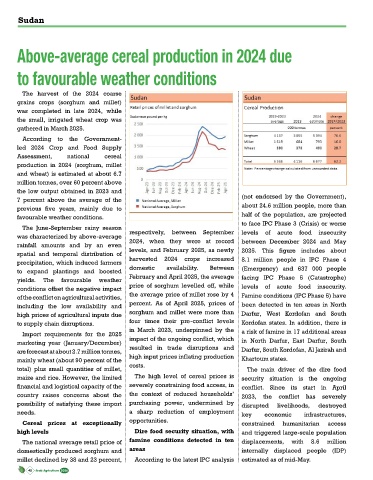
      production in 2024 (sorghum, millet
      and wheat) is estimated at about 6.7
      million tonnes, over 60 percent above
      the low output obtained in 2023 and
      7  percent  above  the  average  of  the                                (not endorsed by the Government),
      previous  five  years,  mainly  due  to                                 about 24.6 million people, more than
      favourable weather conditions.                                          half of the population, are projected
                                                                              to face IPC Phase 3 (Crisis) or worse
        The June-September rainy season
      was characterized by above-average   respectively, between September    levels of acute food insecurity
      rainfall amounts and by an even     2024,  when  they  were  at  record   between December 2024 and May
      spatial  and temporal  distribution  of   levels, and February 2025, as newly   2025.  This  figure  includes  about
      precipitation, which induced farmers   harvested 2024 crops increased   8.1 million people in IPC Phase 4
      to expand plantings and boosted     domestic    availability.  Between  (Emergency) and 637 000 people
      yields.  The   favourable  weather  February and April 2025, the average   facing  IPC  Phase  5 (Catastrophe)
      conditions offset the negative impact   price of sorghum levelled off, while   levels of acute food insecurity.
      of the conflict on agricultural activities,   the average price of millet rose by 4   Famine conditions (IPC Phase 5) have
      including the low availability and   percent. As of April 2025, prices of   been detected in ten areas in North
      high prices of agricultural inputs due   sorghum and millet were more than   Darfur, West Kordofan and South
      to supply chain disruptions.        four times their  pre-conflict levels   Kordofan states. In addition, there is
                                          in March 2023, underpinned by the   a risk of famine in 17 additional areas
        Import requirements for  the 2025
      marketing year (January/December)   impact of the ongoing conflict, which   in North Darfur, East Darfur, South
      are forecast at about 2.7 million tonnes,   resulted in trade disruptions and   Darfur, South Kordofan, Al Jazirah and
      mainly wheat (about 90 percent of the   high input prices inflating production   Khartoum states.
                                          costs.
      total) plus small quantities of millet,                                   The main driver of the dire food
      maize and rice. However, the limited   The high level of cereal prices is   security situation is the ongoing
      financial and logistical capacity of the   severely constraining food access, in   conflict. Since its start in April
      country raises concerns about the   the context of reduced households’   2023, the conflict has severely
      possibility  of  satisfying these import   purchasing power, undermined by   disrupted  livelihoods,  destroyed
      needs.                              a sharp reduction of employment     key    economic     infrastructures,
        Cereal prices  at exceptionally   opportunities.                      constrained  humanitarian   access
      high levels                           Dire food security situation, with   and triggered large-scale population
        The national average retail price of   famine conditions detected in ten   displacements,  with  8.6  million
      domestically produced sorghum and   areas                               internally displaced people (IDP)
      millet declined by 38 and 23 percent,   According to the latest IPC analysis   estimated as of mid-May.
          42    Arab Agriculture  2026

