


Page 24 - AA 2023 Year Book Website
P. 24
Djibouti


       US$20 MILLION GRANT TO HELP DJIBOUTI MITIGATE FOOD SECURITY

         RISKS RESULTING FROM MULTIPLE CRISES AND CLIMATE CHANGE


        The  World Bank  on  October 26   World  Bank Resident  Representative   security crises  and provide a rapid
       approved an International Development   in Djibouti. “The new project will help   response, including  the  management  of
       Association (IDA) grant of US$20 million   the country ensure the availability  of a   an emergency food stock, and developing
       to help  Djibouti mitigate food  security   minimum level of basic food commodities   the  skills  of  both the  public  and  private
       risks posed by food supply shocks and   as one of the instruments to strengthen its   sectors on price risk management.”
       severe droughts affecting the country.  capacity  to withstand  future  food supply
                                          shocks.”                              The project supports the Government
        The   Djibouti  Emergency   Food                                      of Djibouti’s response  to the multiple
       Security Crisis Response Project will   The Project will  support  drought-  crises and the preparation of a national
       establish an emergency food stock to   affected farmers and livestock-holding   food security  crisis preparedness plan
       allow  the Government to  respond to   households  to restore their productive   to ensure  an effective  and coordinated
       potential food shortages in the event of   assets and initiate climate adaptation   response  to future crisis.  The project
       market shocks, thus reducing the impact   activities for sustained food  security.   also complements the recently approved
       of such shocks particularly on the poor.   Project  activities  will  finance  Emergency Social Protection Crisis
       The project will also directly target   agricultural inputs to support crop and   Response Project which aims to provides
       drought-affected  rural  communities  fodder production; small greenhouses   cash transfers to targeted households
       across  the  country  and  support  equipped with drip irrigation to help   and strengthen  social protection and
       approximately  8,000   households,  increase  agricultural  production  community  resilience  mechanisms  to
       including farmers and livestock herders,   and provide means of adaptation to   respond to future crises.
       through  improved access to drinking   climate change; as well as assets
       and irrigation water as well as livelihood   and essential inputs for livestock   The World Bank in Djibouti
       restoration activities.  The  project  is   production. Project activities will also
       estimated to reach approximately 21%   include  training programs for farmers   The World Bank’s portfolio in Djibouti
       of the total rural population of Djibouti,   and livestock herders on climate resilient   consists of 20 projects, worth a total
       with priority given  to women-headed   practices and technologies.     US$438.8  million in IDA financing.  The
       households and the youth.                                              portfolio  focuses  on  education, health,
                                            “The project will support public and   social safety nets, energy, rural and
        Djibouti – which meets up to 90%   private  sector  capacity  building  and   urban development, modernizing public
       of its food needs  through imports –   technical  assistance  to improve  the   administration, digital development,
       has been severely impacted by  the   country’s resilience  to future shocks,”   strengthening governance and regional
       repercussions of the war  in Ukraine   said  Eva Hasiner,  World Bank  Task   infrastructure, and on private sector
       and resulting  food  supply disruptions.   Team  Leader  for  the  project. “This   development, with an emphasis on
       The  COVID-19 pandemic  and the    includes  strengthening  the  capacity   women and youth.
       conflict in neighbouring Ethiopia have   of the Government to anticipate food
       led to a deterioration in the country’s
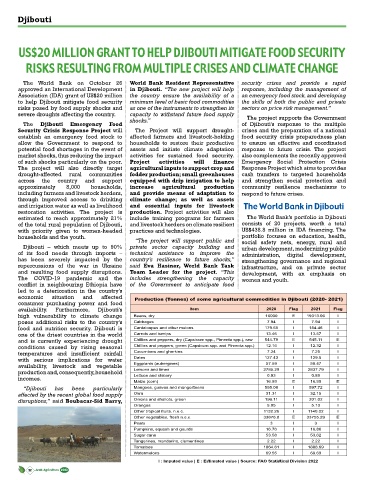
       economic   situation  and  affected  Production (Tonnes) of some agricultural commodities in Djibouti (2020- 2021)
       consumer purchasing power and food
       availability.  Furthermore,  Djibouti’s                Item                    2020   Flag   2021   Flag
       high vulnerability  to climate change   Beans, dry                             16000   E    19313.06  I
       poses  additional risks to the country’s   Cabbages                            7.94     I    7.94     I
       food and nutrition security. Djibouti is   Cantaloupes and other melons        179.65   I    184.46   I
       one of the driest countries in the world   Carrots and turnips                 13.46    I    13.57    I
       and is currently experiencing drought   Chillies and peppers, dry (Capsicum spp., Pimenta spp.), raw  544.78  E  545.11  E
       conditions  caused by rising  seasonal   Chillies and peppers, green (Capsicum spp. and Pimenta spp.)  12.16  I  12.32  I
       temperatures and insufficient rainfall   Cucumbers and gherkins                7.24     I    7.25     I
       with serious  implications for water   Dates                                   127.43   I    129.5    I
       availability, livestock  and vegetable   Eggplants (aubergines)                57.59    I    58.47    I
       production and, consequently, household   Lemons and limes                    2785.29   I   2837.79   I
                                                                                      0.93
                                                                                                    0.89
       incomes.                             Lettuce and chicory                       16.93   E I   16.99   E I
                                            Maize (corn)
        “Djibouti  has  been   particularly  Mangoes, guavas and mangosteens          595.08   I    597.72   I
       affected by the recent global food supply   Okra                               31.31    I    32.15    I
       disruptions,” said  Boubacar-Sid  Barry,   Onions and shallots, green          196.11   I    201.02   I
                                            Oranges                                   5.05     I    5.13     I
                                            Other tropical fruits, n.e.c.            1132.26   I   1140.02   I
                                            Other vegetables, fresh n.e.c.           33876.8  E    33755.29  E
                                            Pears                                      3       I     3       I
                                            Pumpkins, squash and gourds               16.76    I    16.86    I
                                            Sugar cane                                53.58    I    53.62    I
                                            Tangerines, mandarins, clementines        2.22     I    2.22     I
                                            Tomatoes                                 1864.61   I   1888.69   I
                                            Watermelons                               69.55    I    69.69    I
                                                    I : Imputed value | E : Estimated value | Source: FAO Statistical Division 2022
          22    Arab Agriculture  2023

