


Page 28 - AA 2023 Year Book Website
P. 28
Iraq


               EARLY SEASON DRYNESS IN NORTH, ABOVE

                          AVERAGE RAINFALL ELSEWHERE


        While climatic and geographic condi-  cluding Ninewa Province, reached about   lands, the  2023 plan endorses cultiva-
       tions are conducive to agricultural pro-  80 percent of the average, but it was suf-  tion  on  625 000 hectares. The  measure
       duction, the country continues to face   ficient to facilitate  sowing operations.   aims to increase domestic wheat pro-
       structural problems of water  scarcity   However, sustained rainfall amounts in   duction in light of the elevated interna-
       due  to consecutive  seasons  of erratic   February and March are needed to en-  tional prices and concerns about tighter
       rainfall and decreases in transboundary   sure an adequate crop development.   availability on the global markets, par-
       river flows, limiting water availability for   According to the latest seasonal weather   ticularly following the war in Ukraine.
       irrigation.                         forecast for the January to March 2023   The increase in wheat area is likely to be
                                           period, rainfall amounts in the north are   compensated by a decrease in the area
        The planting of winter cereal crops,   expected to be below average.  planted with barley.
       for harvest from April 2023, was  com-
       pleted in December. Although cumula-  No  shortages  of inputs for  crop pro-  Below average 2022 cereal
       tive rainfall between October 2022 and   duction are reported. However, farmers
       mid January 2023 reached average lev-  complain  of  delayed  payments  for  the   harvest due to drought and
       els, amounts varied across the country.   grains harvested in 2022 that were de-  policy decisions
       The first  significant rainfall  covering   livered to the Ministry of Trade’s silos.
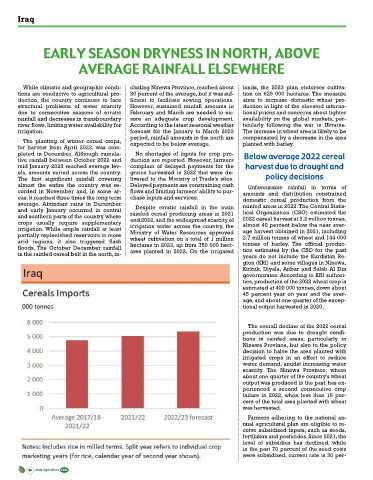
       almost the entire the country was  re-  Delayed payments are constraining cash   Unfavourable rainfall in terms of
       corded in November  and, in some  ar-  flows and limiting farmers’ ability to pur-  amounts and distribution constrained
       eas, it reached three times the long term   chase inputs and services.  domestic  cereal production  from  the
       average. Abundant rains in December   Despite erratic  rainfall  in the main   rainfed areas in 2022. The Central Statis-
       and early January occurred  in central   rainfed cereal producing areas in 2021   tical Organization  (CSO) estimated the
       and southern parts of the country where   and 2022, and the widespread scarcity of   2022 cereal harvest at 3.2 million tonnes,
       crops usually require supplementary   irrigation water across  the country, the   almost 40 percent below the near aver-
       irrigation. While  ample  rainfall at least   Ministry of  Water Resources approved   age harvest obtained in 2021, including
       partially replenished reservoirs in more   wheat cultivation on a total of 1 million   2.7 million tonnes of wheat and 144 000
       arid regions, it also triggered flash   hectares in 2023, up from 750 000 hect-  tonnes of barley.  The official  produc-
       floods. The October December  rainfall   ares planted in 2022. On the irrigated   tion estimates by the CSO  for the past
       in the rainfed cereal belt in the north, in-                           years do not include the Kurdistan Re-
                                                                              gion (KRI) and some villages in Ninewa,
                                                                              Kirkuk, Diyala, Anbar and Salah Al Din
                                                                              governorates. According to KRI authori-
                                                                              ties, production of the 2022 wheat crop is
                                                                              estimated at 400 000 tonnes, down about
                                                                              45 percent year on year and the aver-
                                                                              age, and about one quarter of the excep-
                                                                              tional output harvested in 2020.


                                                                                The overall decline of the 2022 cereal
                                                                              production  was due to drought condi-
                                                                              tions in rainfed areas, particularly in
                                                                              Ninewa Province, but also to the policy
                                                                              decision to halve the area planted with
                                                                              irrigated crops in  an effort to reduce
                                                                              water demand, amidst increasing water
                                                                              scarcity.  The Ninewa  Province, where
                                                                              about one quarter of the country’s wheat
                                                                              output was produced in the past, has ex-
                                                                              perienced a  second consecutive crop
                                                                              failure in 2022,  when less than  15  per-
                                                                              cent of the total area planted with wheat
                                                                              was harvested.
                                                                                Farmers  adhering  to the  national an-
                                                                              nual agricultural plan are eligible to re-
                                                                              ceive subsidized inputs, such as seeds,
                                                                              fertilizers and pesticides. Since 2021, the
                                                                              level of subsidies has declined, while
                                                                              in the past 70 percent of the seed costs
                                                                              were subsidized, current rate is 30 per-

          26    Arab Agriculture  2023

