


Page 22 - AWA Vol.41-No.8
P. 22
FISHERIES AND FISH FARMING


                                    Aquaponics – Produce more food


                                                      with less footprint


              by Annemarie Bremner


         Growing populations, shrinking
        arable land, rising input costs, and
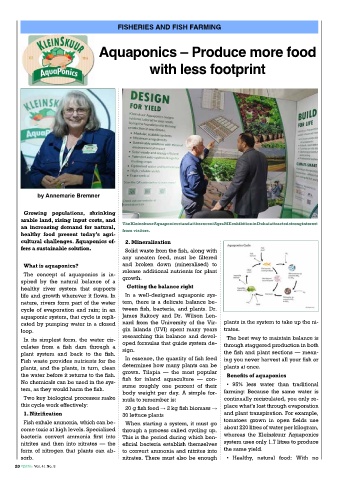
        an increasing demand for natural,   The Kleinskuur Aquaponics stand at the recent AgraME exhibition in Dubai attracted strong interest
        healthy  food  present  today’s  agri-  from visitors.
        cultural challenges. Aquaponics of-  2. Mineralisation
        fers a sustainable solution.         Solid waste from the fish, along with
                                            any  uneaten  feed,  must  be  filtered
         What is aquaponics?                and  broken  down  (mineralised)  to
                                            release additional nutrients for plant
         The  concept  of  aquaponics  is  in-
        spired  by  the  natural  balance  of  a   growth.
        healthy  river  system  that  supports    Getting the balance right
        life and growth wherever it flows. In   In  a  well-designed  aquaponic  sys-
        nature,  rivers  form  part  of  the  water   tem,  there  is  a  delicate  balance  be-
        cycle  of  evaporation  and  rain;  in  an   tween  fish,  bacteria,  and  plants.  Dr.
        aquaponic system, that cycle is repli-  James  Rakocy  and  Dr.  Wilson  Len-
        cated by pumping water in a closed   nard  from  the  University  of  the  Vir-  plants in the system to take up the ni-
        loop.                               gin  Islands  (UVI)  spent  many  years   trates.
                                            researching  this  balance  and  devel-
         In  its  simplest  form,  the  water  cir-                              The best way to maintain balance is
        culates  from  a  fish  dam  through  a   oped formulas that guide system de-  through staggered production in both
                                            sign.
        plant  system  and  back  to  the  fish.                                the  fish  and  plant  sections  —  mean-
        Fish waste provides nutrients for the   In essence, the quantity of fish feed   ing you never harvest all your fish or
        plants, and the plants, in turn, clean   determines how many plants can be   plants at once.
        the water before it returns to the fish.   grown.  Tilapia  —  the  most  popular   Benefits of aquaponics
        No chemicals can be used in the sys-  fish  for  inland  aquaculture  —  con-  •  95%  less  water  than  traditional
                                            sume  roughly  one  percent  of  their
        tem, as they would harm the fish.
                                            body  weight  per  day.  A  simple  for-  farming:  Because  the  same  water  is
         Two key biological processes make   mula to remember is:               continually recirculated, you only re-
        this cycle work effectively:                                            place what’s lost through evaporation
                                             20 g fish feed → 2 kg fish biomass →
         1. Nitrification                   30 lettuce plants                   and plant transpiration. For example,
         Fish exhale ammonia, which can be-  When  starting  a  system,  it  must  go   tomatoes  grown  in  open  fields  use
        come toxic at high levels. Specialized   through a process called cycling up.   about 220 litres of water per kilogram,
        bacteria  convert  ammonia  first  into   This is the period during which ben-  whereas  the  Kleinskuur  Aquaponics
        nitrites  and  then  into  nitrates  —  the   eficial  bacteria  establish  themselves   system uses only 1.7 litres to produce
        form  of  nitrogen  that  plants  can  ab-  to convert ammonia and nitrites into   the same yield.
        sorb.                               nitrates.  There  must  also  be  enough   •  Healthy,  natural  food:  With  no
       20      Vol. 41 No. 8

