


Page 20 - AWA Vol.41-No.8
P. 20
FISHERIES AND FISH FARMING


                       Broodstock Diets – An Overview


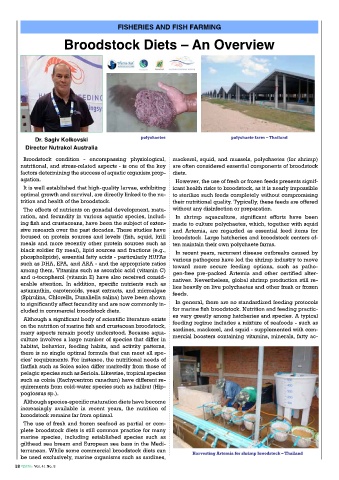
                                                   polychaetes                    polychaete farm – Thailand
             Dr. Sagiv Kolkovski
          Director Nutrakol Australia
         Broodstock  condition  -  encompassing  physiological,   mackerel,  squid,  and  mussels,  polychaetes  (for  shrimp)
        nutritional, and stress-related aspects - is one of the key   are often considered essential components of broodstock
        factors determining the success of aquatic organism prop-  diets.
        agation.                                               However, the use of fresh or frozen feeds presents signif-
         It is well established that high-quality larvae, exhibiting   icant health risks to broodstock, as it is nearly impossible
        optimal growth and survival, are directly linked to the nu-  to sterilize such feeds completely without compromising
        trition and health of the broodstock.                 their nutritional quality. Typically, these feeds are offered
         The effects of nutrients on gonadal development, matu-  without any disinfection or preparation.
        ration, and fecundity in various aquatic species, includ-  In  shrimp  aquaculture,  significant  efforts  have  been
        ing fish and crustaceans, have been the subject of exten-  made to culture polychaetes, which, together with squid
        sive research over the past decades. These studies have   and Artemia, are regarded as essential feed items for
        focused  on  protein  sources  and  levels  (fish,  squid,  krill   broodstock. Large hatcheries and broodstock centers of-
        meals  and  more  recently  other  protein  sources  such  as   ten maintain their own polychaete farms.
        black soldier fly meal), lipid sources and fractions (e.g.,   In recent years, recurrent disease outbreaks caused by
        phospholipids), essential fatty acids - particularly HUFAs   various pathogens have led the shrimp industry to move
        such as DHA, EPA, and ARA - and the appropriate ratios   toward  more  secure  feeding  options,  such  as  patho-
        among them. Vitamins such as ascorbic acid (vitamin C)   gen-free  pre-packed  Artemia  and  other  certified  alter-
        and α-tocopherol (vitamin E) have also received consid-  natives. Nevertheless, global shrimp production still re-
        erable  attention.  In  addition,  specific  nutrients  such  as   lies heavily on live polychaetes and other fresh or frozen
        astaxanthin, carotenoids, yeast extracts, and microalgae   feeds.
        (Spirulina, Chlorella, Dunaliella salina) have been shown
        to significantly affect fecundity and are now commonly in-  In general, there are no standardized feeding protocols
        cluded in commercial broodstock diets.                for marine fish broodstock. Nutrition and feeding practic-
                                                              es vary greatly among hatcheries and species. A typical
         Although a significant body of scientific literature exists
        on the nutrition of marine fish and crustacean broodstock,   feeding regime includes a mixture of seafoods - such as
                                                              sardines, mackerel, and squid - supplemented with com-
        many aspects remain poorly understood. Because aqua-
        culture involves a large number of species that differ in   mercial boosters containing vitamins, minerals, fatty ac-
        habitat,  behavior,  feeding  habits,  and  activity  patterns,
        there is no single optimal formula that can meet all spe-
        cies’ requirements. For instance, the nutritional needs of
        flatfish such as Solea solea differ markedly from those of
        pelagic species such as Seriola. Likewise, tropical species
        such as cobia (Rachycentron canadum) have different re-
        quirements from cold-water species such as halibut (Hip-
        poglossus sp.).
         Although species-specific maturation diets have become
        increasingly  available  in  recent  years,  the  nutrition  of
        broodstock remains far from optimal.
         The use of fresh and frozen seafood as partial or com-
        plete broodstock diets is still common practice for many
        marine  species,  including  established  species  such  as
        gilthead sea bream and European sea bass in the Medi-
        terranean. While some commercial broodstock diets can        Harvesting Artemia for shrimp broodstock – Thailand
        be used exclusively, marine organisms such as sardines,
       18      Vol. 41 No. 8

