


Page 45 - AA 2024
P. 45
Syria


               FAO provides a climate smart technology to improve

                         agricultural production in Eastern Ghouta


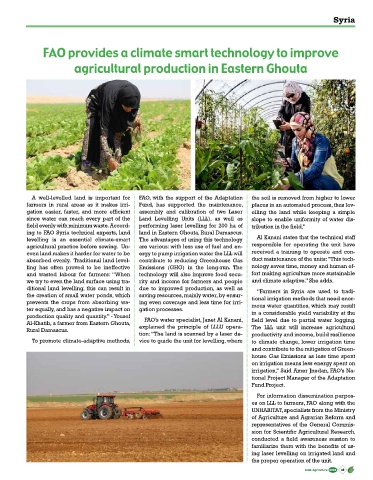
           A well-levelled land is important for   FAO, with the support of the Adaptation   the soil is removed from higher to lower
          farmers in rural areas as it makes irri-  Fund, has supported the maintenance,   places in an automated process, thus lev-
          gation easier, faster, and more efficient   assembly and calibration of two Laser   elling the  land  while  keeping a  simple
          since water can reach every part of the   Land Levelling Units (LLL), as well as   slope to enable uniformity of water dis-
          field evenly with minimum waste. Accord-  performing laser levelling for 200 ha of   tribution in the field,”
          ing to FAO Syria technical experts, land   land in Eastern Ghouta, Rural Damascus.
          levelling  is  an  essential  climate-smart   The advantages of using this technology   Al Kanani states that the technical staff
          agricultural practice before sowing.  Un-  are various: with less use of fuel and en-  responsible for operating the unit have
          even land makes it harder for water to be   ergy to pump irrigation water the LLL will   received a training to operate and con-
          absorbed evenly.  Traditional land level-  contribute to reducing Greenhouse Gas   duct maintenance of the units: “This tech-
          ling has often proved to be ineffective   Emissions (GHG) in the long-run.  The   nology saves time, money and human ef-
          and wasted labour for farmers:  “When   technology will also improve food secu-  fort making agriculture more sustainable
          we try to even the land surface using tra-  rity and income for farmers and people   and climate adaptive.” She adds.
          ditional land levelling, this can result in   due to improved production, as well as   “Farmers in Syria are used to tradi-
          the creation of small water ponds, which   saving resources, mainly water, by ensur-  tional irrigation methods that need enor-
          prevents  the  crops  from  absorbing  wa-  ing even coverage and less time for irri-  mous water quantities, which may result
          ter equally, and has a negative impact on   gation processes.
          production quality and quantity.” - Yousef   FAO’s water specialist, Janet Al Kanani,   in a considerable yield variability at the
          Al-Khatib, a farmer from Eastern Ghouta,                               field level due to partial water logging.
          Rural Damascus.                    explained the principle of LLLU opera-  The LLL unit will increase agricultural
                                             tion: “The land is scanned by a laser de-  productivity and income, build resilience
           To promote climate-adaptive methods,   vice to guide the unit for levelling, where   to climate change, lower irrigation time
                                                                                 and contribute to the mitigation of Green-
                                                                                 house Gas Emissions as less time spent
                                                                                 on irrigation means less energy spent on
                                                                                 irrigation,” Said Amer Jnedan, FAO’s Na-
                                                                                 tional Project Manager of the Adaptation
                                                                                 Fund Project.
                                                                                   For information dissemination purpos-
                                                                                 es on LLL to farmers, FAO along with the
                                                                                 UNHABITAT, specialists from the Ministry
                                                                                 of Agriculture and Agrarian Reform and
                                                                                 representatives of the General Commis-
                                                                                 sion for Scientific Agricultural Research,
                                                                                 conducted a field awareness session to
                                                                                 familiarize them with the benefits of us-
                                                                                 ing laser levelling on irrigated land and
                                                                                 the proper operation of the unit.
                                                                                                  Arab Agriculture  2024  43

