


Page 30 - AA 2024
P. 30
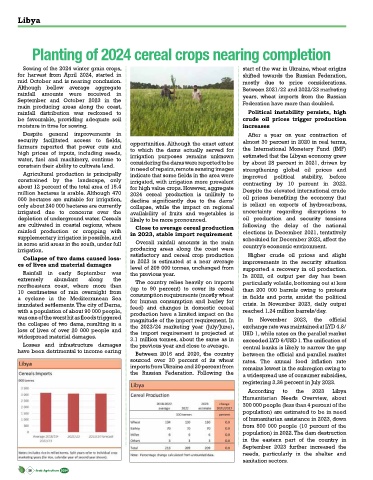
Libya


           Planting of 2024 cereal crops nearing completion

        Sowing of the 2024 winter grain crops,                                start of the war in Ukraine, wheat origins
       for harvest from April 2024, started in                                shifted towards the Russian Federation,
       mid October and is nearing conclusion.                                 mostly  due  to price  considerations.
       Although bellow average aggregate                                      Between 2021/22 and 2022/23 marketing
       rainfall amounts were received in                                      years, wheat imports from the Russian
       September and  October  2023  in the                                   Federation have more than doubled.
       main producing  areas  along the  coast,
       rainfall distribution was reckoned to                                    Political instability persists, high
       be favourable,  providing adequate soil                                crude oil prices trigger production
       moisture in time for sowing.                                           increases
        Despite general improvements in                                         After a year on year contraction of
       security facilitated access to fields,                                 almost 30 percent in 2020 in real terms,
       farmers reported that power cuts and   opportunities. Although the exact extent   the International Monetary Fund (IMF)
       high prices of inputs, including seeds,   to  which  the  dams  actually  served  for   estimated that the Libyan economy grew
                                           irrigation purposes remains unknown
       water, fuel and machinery, continue to   considering the dams were reported to be   by about 28 percent in 2021, driven by
       constrain their ability to cultivate land.  in need of repairs, remote sensing images   strengthening global oil prices and
        Agricultural production is  principally   indicate that some fields in the area were   improved  political  stability,  before
       constrained by the landscape, only   irrigated, with irrigation more prevalent   contracting by 10 percent in 2022.
       about 12 percent of the total area of 15.4   for high value crops. However, aggregate
       million hectares is arable. Although 470   2024 cereal production is unlikely to   Despite the elevated international crude
       000  hectares  are  suitable  for  irrigation,   decline significantly due to the dams’   oil prices benefiting the economy that
       only about 240 000 hectares are currently   collapse, while the impact on regional   is  reliant on exports  of  hydrocarbons,
       irrigated due to concerns over the   availability of fruits and vegetables is   uncertainty regarding disruptions to
       depletion of underground water. Cereals   likely to be more pronounced.  oil production and security tensions
       are cultivated in coastal regions, where   Close to average cereal production   following the delay of the national
       rainfed production or cropping with   in 2023, stable import requirement  elections in December 2021, tentatively
       supplementary irrigation is possible, and                              scheduled for December 2023, affect the
       in some arid areas in the south, under full   Overall rainfall amounts in the main   country’s economic environment.
       irrigation.                         producing areas along the coast were
        Collapse of two dams caused loss-  satisfactory and cereal crop production   Higher crude oil prices and slight
                                           in 2023 is estimated at a near average
       es of lives and material damages    level of 209 000 tonnes, unchanged from   improvements in the security situation
        Rainfall in early September was    the previous year.                 supported a recovery in oil production.
       extremely  abundant   along   the    The country relies heavily on imports   In 2022, oil output per day has been
       northeastern coast, where more than   (up to 90 percent) to cover its cereal   particularly volatile, bottoming out at less
       10  centimetres  of  rain  overnight  from   consumption requirements (mostly wheat   than 200 000 barrels owing to protests
       a cyclone in the Mediterranean Sea   for human  consumption and  barley for   in fields and ports, amidst the political
       inundated settlements. The city of Derna,   feed) and changes in domestic cereal   crisis. In November 2023, daily output
       with a population of about 90 000 people,   production have a limited impact on the   reached 1.24 million barrels/day.
       was one of the worst hit as floods triggered   magnitude of the import requirement. In   In  November  2023,  the  official
       the collapse of two dams, resulting in a   the 2023/24 marketing year (July/June),   exchange rate was maintained at LYD 4.8/
       loss of lives of over 20 000 people and   the import requirement is projected at   USD 1, while rates on the parallel market
       widespread material damages.        3.1 million tonnes, about the same as in   exceeded LYD 6/USD 1. The unification of
        Losses and infrastructure damages   the previous year and close to average.  central banks is likely to narrow the gap
       have been detrimental to income earing   Between 2016 and 2020, the country   between the official and parallel market
                                           sourced over 30 percent of its wheat   rates.  The annual food inflation rate
                                           imports from Ukraine and 20 percent from   remains lowest in the subregion owing to
                                           the Russian Federation. Following the   a widespread use of consumer subsidies,
                                                                              registering 3.36 percent in July 2023.
                                                                                According  to  the   2023  Libya
                                                                              Humanitarian Needs Overview, about
                                                                              300 000 people (less than 4 percent of the
                                                                              population) are estimated to be in need
                                                                              of humanitarian assistance in 2023, down
                                                                              from 800 000 people (10 percent of the
                                                                              population) in 2022. The dam destruction
                                                                              in the eastern part of the country in
                                                                              September 2023 further increased the
                                                                              needs, particularly in the shelter and
                                                                              sanitation sectors.
          28    Arab Agriculture  2024

