


Page 35 - AA 2024
P. 35
Morocco


            Below average cereal production harvested in 2023


           Harvesting of the 2023 main winter grain crops concluded
         in mid July. Cereals, cultivated on slightly over half of the
         arable land, are almost entirely rainfed and their output is
         highly variable year on year depending on rainfall amounts
         and distribution. Out of the past five agricultural seasons,
         four were affected by drought with different degrees of
         intensity.
           Following a favourable start of the season between October
         and December 2022, large areas of the country experienced
         below average rainfall amounts last January. Then, improved
         rains in February brought some respite to crops in north
         and western areas of the country. Rainfall returned to
         significantly below average levels in March and April, and
         high  temperatures  in  April  accelerated  grain  maturation.
         However, production fared better in some western and
         central parts of the country due to slightly enhanced rainfall
         amounts.
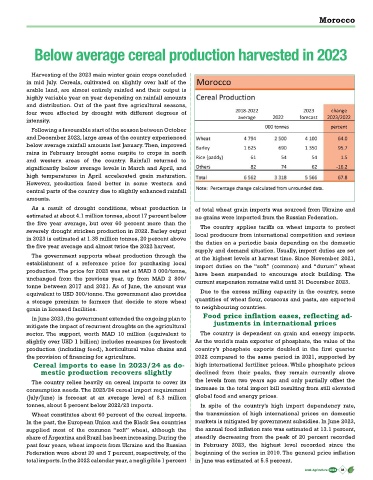
           As a result of drought conditions, wheat production is   of total wheat grain imports was sourced from Ukraine and
         estimated at about 4.1 million tonnes, about 17 percent below   no grains were imported from the Russian Federation.
         the  five  year  average,  but  over  60  percent  more  than  the   The  country  applies tariffs on  wheat  imports to  protect
         severely drought stricken production in 2022. Barley output   local producers from international competition and revises
         in 2023 is estimated at 1.35 million tonnes, 20 percent above
         the five year average and almost twice the 2022 harvest.  the duties on a periodic basis depending on the domestic
                                                               supply and demand situation. Usually, import duties are set
           The government supports wheat production through the   at the highest levels at harvest time. Since November 2021,
         establishment of a reference price for purchasing local   import duties on the “soft” (common) and “durum” wheat
         production. The price for 2023 was set at MAD 3 000/tonne,   have been suspended to encourage stock building.  The
         unchanged from the previous year, up from MAD 2 800/  current suspension remains valid until 31 December 2023.
         tonne between 2017 and 2021. As of June, the amount was
         equivalent to USD 300/tonne. The government also provides   Due to the excess milling capacity in the country, some
         a  storage premium to farmers  that decide to  store wheat   quantities of wheat flour, couscous and pasta, are exported
         grain in licensed facilities.                         to neighbouring countries.
                                                                  Food price inflation eases, reflecting ad-
           In June 2023, the government extended the ongoing plan to
         mitigate the impact of recurrent droughts on the agricultural   justments in international prices
         sector.  The support, worth MAD 10 million (equivalent to   The country is dependent on grain and energy imports.
         slightly over USD 1 billion) includes measures for livestock   As the world’s main exporter of phosphate, the value of the
         production (including feed), horticultural value chains and   country’s phosphate exports doubled in the first quarter
         the provision of financing for agriculture.           2022 compared to the same period in 2021, supported by
            Cereal imports to ease in 2023/24 as do-           high international fertilizer prices. While phosphate prices
              mestic production recovers slightly              declined from their peaks, they remain currently above

           The country relies heavily on cereal imports to cover its   the levels from two years ago and only partially offset the
         consumption needs. The 2023/24 cereal import requirement   increase in the total import bill resulting from still elevated
         (July/June) is forecast at an average level of 8.3 million   global food and energy prices.
         tonnes, about 5 percent below 2022/23 imports.          In spite of the country’s high import dependency rate,
           Wheat constitutes about 60 percent of the cereal imports.   the transmission of high international prices on domestic
         In the past, the European Union and the Black Sea countries   markets is mitigated by government subsidies. In June 2023,
         supplied most of the common  “soft” wheat, although the   the annual food inflation rate was estimated at 13.1 percent,
         share of Argentina and Brazil has been increasing. During the   steadily decreasing from the peak  of 20 percent recorded
         past four years, wheat imports from Ukraine and the Russian   in February 2023, the highest level recorded since the
         Federation were about 20 and 7 percent, respectively, of the   beginning of the series in 2010. The general price inflation
         total imports. In the 2022 calendar year, a negligible 1 percent   in June was estimated at 5.5 percent.
                                                                                                  Arab Agriculture  2024  33

