


Page 35 - AA 2023 Year Book Website
P. 35
Libya


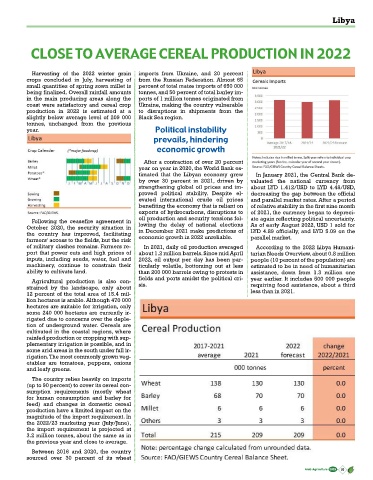
           CLOSE TO AVERAGE CEREAL PRODUCTION IN 2022


           Harvesting of the 2022 winter grain   imports  from Ukraine, and 20 percent
          crops concluded in July, harvesting of   from the Russian Federation. Almost 65
          small quantities of spring sown millet is   percent of total maize imports of 650 000
          being finalized. Overall rainfall amounts   tonnes, and 50 percent of total barley im-
          in the main producing areas along the   ports of 1 million tonnes originated from
          coast were satisfactory and cereal crop   Ukraine, making the country vulnerable
          production  in  2022 is estimated at a   to disruptions in shipments  from the
          slightly below average level of 209 000   Black Sea region.
          tonnes, unchanged from  the  previous
          year.                                    Political instability
                                                  prevails, hindering
                                                   economic growth

                                               After a contraction of over 20 percent
                                             year on year in 2020, the World Bank es-
                                             timated  that  the Libyan economy grew   In January 2021, the Central Bank de-
                                             by over 30 percent in 2021, driven  by   valuated  the national  currency  from
                                             strengthening global oil prices and im-  about  LYD 1.412/USD  to LYD 4.48/USD,
                                             proved political stability. Despite el-  decreasing the gap between the official
                                             evated  international crude oil prices   and parallel market rates. After a period
                                             benefiting the economy that is reliant on   of relative stability in the first nine month
                                             exports of hydrocarbons, disruptions to   of 2021, the currency began to depreci-
                                             oil production and security tensions fol-  ate again reflecting political uncertainty.
           Following the ceasefire agreement  in
          October 2020, the  security situation in   lowing the delay of national elections   As of early August 2022, USD 1 sold for
                                                                                 LYD 4.89 officially, and LYD 5.09 on the
                                             in December  2021  make predictions of
          the country has improved, facilitating   economic growth in 2022 unreliable.  parallel market.
          farmers’ access to the fields, but the risk
          of military clashes remains. Farmers re-  In 2021, daily oil production averaged   According to the 2022 Libya Humani-
          port that power cuts and high prices of   about 1.2 million barrels. Since mid April   tarian Needs Overview, about 0.8 million
          inputs, including seeds, water, fuel and   2022, oil output per day has been  par-  people (10 percent of the population) are
          machinery, continue  to constrain their   ticularly volatile, bottoming out at  less   estimated to be in need of humanitarian
          ability to cultivate land.         than 200 000 barrels owing to protests in   assistance, down from 1.3 million  one
           Agricultural  production is also con-  fields and ports amidst the political cri-  year earlier. It includes 500 000 people
          strained by the landscape, only about   sis.                           requiring food assistance, about a third
          12 percent of the total area of 15.4 mil-                              less than in 2021.
          lion hectares is arable. Although 470 000
          hectares are suitable for irrigation, only
          some 240 000 hectares are currently ir-
          rigated due to concerns over the deple-
          tion of underground water. Cereals are
          cultivated in the coastal regions, where
          rainfed production or cropping with sup-
          plementary irrigation is possible, and in
          some arid areas in the south under full ir-
          rigation. The most commonly grown veg-
          etables are tomatoes, peppers, onions
          and leafy greens.
           The country relies heavily on imports
          (up to 90 percent) to cover its cereal con-
          sumption requirements  (mostly wheat
          for human consumption and barley for
          feed) and changes in domestic cereal
          production have a limited impact on the
          magnitude of the import requirement. In
          the 2022/23 marketing year (July/June),
          the import  requirement is projected at
          3.2 million tonnes, about the same as in
          the previous year and close to average.
           Between 2016  and  2020,  the country
          sourced over 30 percent of its wheat
                                                                                                  Arab Agriculture  2023  33

