


Page 34 - AA 2023 Year Book Website
P. 34
Lebanon


               PLANTING OF 2023 WINTER CEREAL CROPS

                                       TO START SHORTLY


        Planting of the 2023 winter cereal   imported ones resulting in reduced in-  higher share than reported in previous
       crops, the largest share of which is wheat   put application, or substituting with lo-  rounds conducted in late 2021 and April
       in Beqaa Valley, will take place between   cally produced  inputs of  lower quality,   2022.
       late October and early December after   leading to lower marketable production
       seasonal rainfall replenishes  soil mois-  and incomes.
       ture.
                                            Most farmers lack liquidity. Seasonal
        Harvesting of the 2022 winter cereal   credit provided to farmers by input im-
       crops was completed in  July. Although   porters and sellers, has not been avail-
       the season was marked by an uneven   able since October 2019. Up to 2021, an
       temporal distribution of rainfall, weather   arrangement  between  the government
       conditions  were generally favourable   and the Banque du Liban (BdL) allowed
       for crop development. However, low ap-  traders of raw materials, including feed
       plication of inputs due to their high pric-  and agricultural inputs, to finance  im-
       es constrained yields.              ports using a subsidized exchange rate
                                           of LBP 3 900/USD, although the alloca-
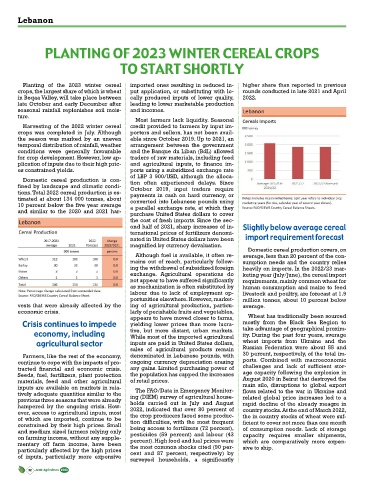
        Domestic  cereal production  is con-  tion often experienced delays. Since
       fined by landscape and climatic condi-  October 2019, input traders require
       tions. Total 2022 cereal production is es-  payments  in cash  on  hard currency, or
       timated at about 134 000 tonnes, about   converted into Lebanese  pounds  using
       10 percent below the five year average   a parallel exchange rate, at which they
       and similar to the 2020 and 2021 har-  purchase United States dollars to cover
                                           the cost of fresh imports. Since the sec-
                                           ond half of 2021, sharp increases of in-  Slightly below average cereal
                                           ternational prices of fertilizers denomi-
                                           nated in United States dollars have been   import requirement forecast
                                           magnified by currency devaluation.
                                                                                Domestic cereal production covers, on
                                            Although fuel is available, it often re-  average, less than 20 percent of the con-
                                           mains out of reach, particularly follow-  sumption needs and the country relies
                                           ing the withdrawal of subsidized foreign   heavily on imports. In the 2022/23 mar-
                                           exchange. Agricultural operations do   keting year (July/June), the cereal import
                                           not appear to have suffered significantly   requirements, mainly common wheat for
                                           as mechanization is often substituted by   human consumption and maize to feed
                                           labour due  to lack of  employment  op-  livestock and poultry, are forecast at 1.9
                                           portunities elsewhere. However, market-  million tonnes, about 10 percent below
       vests that were already affected by the   ing of agricultural production, particu-  average.
       economic crisis.                    larly of perishable fruits and vegetables,
                                           appears to have moved closer to farms,   Wheat has traditionally been sourced
        Crisis continues to impede         yielding lower prices than more lucra-  mostly from the Black Sea Region  to
            economy, including             tive, but more distant, urban markets.   take advantage of geographical proxim-
                                                                              ity. During the past four years, average
                                           While most of the imported agricultural
             agricultural sector           inputs are paid in United States dollars,   wheat imports from Ukraine and the
                                           sales of  agricultural products remain   Russian Federation were about 55 and
        Farmers, like the rest of the economy,   denominated in Lebanese pounds, with   30 percent, respectively, of the total im-
       continue to cope with the impacts of pro-  ongoing currency depreciation erasing   ports. Combined with macroeconomic
       tracted financial and economic  crisis.   any gains. Limited purchasing power of   challenges and lack of sufficient stor-
       Seeds, fuel, fertilizers, plant protection   the population has capped the increases   age capacity following the explosion in
       materials, feed and other agricultural   of retail prices.             August 2020 in Beirut that destroyed the
       inputs are available on markets in rela-  The FAO/Data in Emergency Monitor-  main silo, disruptions to global export
       tively adequate quantities similar to the   ing (DIEM) survey of agricultural house-  flows related to the war in Ukraine and
       previous three seasons that were already   holds carried out in July and August   related global price increases led to a
       hampered by the ongoing  crisis. How-  2022, indicated that  over 80 percent of   rapid decline of the already meagre in
       ever, access to agricultural inputs, most   the crop producers faced some produc-  country stocks. At the end of March 2022,
       of which are imported, continue to be   tion difficulties, with the most frequent   the in country stocks of wheat were suf-
       constrained by their high prices. Small   being access to fertilizers (72 percent),   ficient to cover not more than one month
       and medium sized farmers relying only   pesticides (59 percent) and labour (43   of consumption needs. Lack of storage
       on farming income, without any supple-  percent). High food and fuel prices were   capacity  requires smaller shipments,
       mentary off farm income, have  been   the most common shocks cited (90 per-  which are comparatively more expen-
       particularly affected by the high prices   cent and 87 percent, respectively) by   sive to ship.
       of inputs, particularly more expensive   surveyed  households, a significantly

          32    Arab Agriculture  2023

