


Page 28 - AWA Vol.41-No.9 issue
P. 28
IRRIGATION

                 Small Flow Paths, Big Intelligence: Meet the


          "Octagon of Warriors" Inside T-tape Irrigation Pipe


         Have you ever wondered why one
        roll of black T-tape irrigation  pipe
        saves water while another wastes it?
        Or why one delivers water uniform-
        ly, while another has inconsistent
        output? The answer lies in the preci-
        sion of its internal "flow paths."
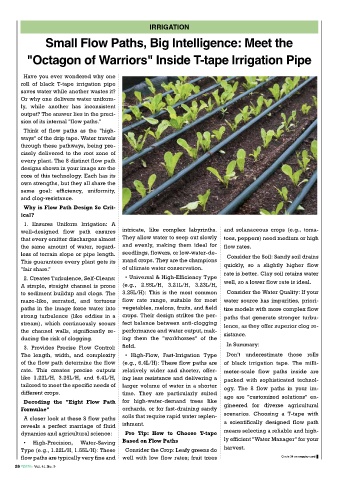
         Think of flow paths as the "high-
        ways" of the drip tape. Water travels
        through these pathways, being pre-
        cisely delivered to the root zone of
        every plant. The 8 distinct flow path
        designs shown in your image are the
        core of this technology. Each has its
        own strengths, but they all share the
        same  goal:  efficiency,  uniformity,
        and clog-resistance.
         Why is Flow Path Design So Crit-
        ical?
         1.  Ensures  Uniform  Irrigation:  A
        well-designed flow path ensures     intricate, like complex labyrinths.   and solanaceous crops (e.g., toma-
        that every emitter discharges almost   They allow water to seep out slowly   toes, peppers) need medium or high
        the same amount of water, regard-   and evenly, making them ideal for   flow rates.
        less of terrain slope or pipe length.   seedlings, flowers, or low-water-de-  Consider the Soil: Sandy soil drains
        This guarantees every plant gets its   mand crops. They are the champions   quickly,  so  a  slightly  higher  flow
        "fair share."                       of ultimate water conservation.     rate is better. Clay soil retains water
         2. Creates Turbulence, Self-Cleans:   • Universal & High-Efficiency Type
        A simple, straight channel is prone   (e.g., 2.55L/H, 3.21L/H, 3.23L/H,   well, so a lower flow rate is ideal.
        to sediment buildup and clogs. The   3.25L/H): This is the most common   Consider the Water Quality: If your
        maze-like, serrated, and tortuous   flow rate range, suitable for most   water source has impurities, priori-
        paths in the image force water into   vegetables, melons, fruits, and field   tize models with more complex flow
        strong turbulence (like eddies in a   crops. Their design strikes the per-  paths that generate stronger turbu-
        stream), which continuously scours   fect  balance  between  anti-clogging   lence, as they offer superior clog re-
        the  channel  walls,  significantly  re-  performance and water output, mak-  sistance.
        ducing the risk of clogging.        ing them the "workhorses" of the
         3. Provides Precise Flow Control:   field.                              In Summary:
        The length, width, and complexity    •  High-Flow,  Fast-Irrigation  Type   Don't  underestimate  those  rolls
        of the flow path determine the flow   (e.g., 6.4L/H): These flow paths are   of black irrigation tape. The milli-
        rate. This creates precise outputs   relatively wider and shorter, offer-  meter-scale flow paths inside are
        like 1.22L/H, 3.25L/H, and 6.4L/H,   ing less resistance and delivering a   packed with sophisticated technol-
        tailored to meet the specific needs of   larger volume of water in a shorter   ogy. The 8 flow paths in your im-
        different crops.                    time. They are particularly suited   age are "customized solutions" en-
         Decoding the "Eight Flow Path      for high-water-demand trees like    gineered for diverse agricultural
        Formulae"                           orchards, or for fast-draining sandy   scenarios. Choosing a T-tape with
         A closer look at these 8 flow paths   soils that require rapid water replen-
        reveals  a  perfect marriage  of  fluid   ishment.                      a  scientifically  designed  flow  path
        dynamics and agricultural science:   Pro  Tip: How to Choose  T-tape    means selecting a reliable and high-
         •   High-Precision,  Water-Saving  Based on Flow Paths                 ly efficient "Water Manager" for your
        Type (e.g., 1.22L/H, 1.55L/H): These   Consider the Crop: Leafy greens do   harvest.
        flow paths are typically very fine and   well with low flow rates; fruit trees              Circle 34 on enquiry card
       26      Vol. 41 No. 9

