


Page 17 - AWA_No_7 A & E copy.indd
P. 17
ANIMAL HEALTH
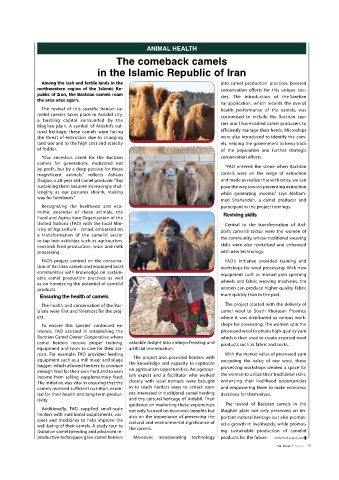
                                          The comeback camels

                                   in the Islamic Republic of Iran

                Among&the&lush&and&fertile&lands&in&the&                       into  camel  production  practices  boosted
              northwestern& region& of& the& Islamic& Re6                      conservation  efforts  for  this  unique  spe-
              public&of&Iran,&the&Bactrian&camels&roam&                        cies.  The  introduction  of  the Sareban
              the&area&once&again.
                                                                               Yar application,  which  records  the  overall
                The  revival  of  this  specific  Iranian  ca-                 health  performance  of  the  camels,  was
              melid species takes place in Ardabil city,                       customised  to  include  the  Bactrian  spe-
              a  bustling  capital  surrounded  by  the                        cies and thus enabled camel producers to
              Moghan plain. A symbol of Ardabil’s cul-
              tural  heritage,  these  camels  were  facing                    efficiently manage their herds. Microchips
              the threat of extinction due to changing                         were also introduced to identify the cam-
              land use and to the high cost and scarcity                       els, helping the government to keep track
              of fodder.                                                       of  the  population  and  further  strategic
                “Our  ancestors  cared  for  the  Bactrian                     conservation efforts.
              camels  for  generations,  motivated  not
              by profit, but by a deep passion for these                        “FAO  entered  the  scene  when  Bactrian
              magnificent  animals,”  reflects  Ashkan                         camels  were  on  the  verge  of  extinction
              Dadjoo, a 28-year-old camel producer. “But                       and made us realize that with unity, we can
              sustaining them became increasingly chal-                        pave the way toward preventing extinction
              lenging  as  our  pastures  shrank,  making                      while  generating  income,”  says  Moham-
              way for farmlands.”
                                                                               mad  Shahandeh,  a  camel  producer  and
                Recognizing  the  livelihood  and  eco-                        participant in the project trainings.
              nomic  potential  of  these  animals,  the
              Food and Agriculture Organization of the                           Reviving skills
              United Nations (FAO) with the local Min-                          Central  to  the  transformation  of  Ard-
              istry of Agriculture - Jahad, embarked on                        abil’s  camelid  sector  were  the  women  of
              a  transformation  of  the  camelid  sector                      the community, whose traditional weaving
              to tap into activities such as agritourism,
              livestock feed production, wool and milk                         skills  were  also  revitalised  and  enhanced
              processing.                                                      with new technology.
                FAO’s  project  centred  on  the  conserva-                     FAO’s  initiative  provided  training  and
              tion of Bactrian camels and equipped local                       workshops for wool processing. With new
              communities  with  knowledge  on  sustain-                       equipment such as manual yarn spinning
              able  camel  production  practices  as  well
              as on harnessing the potential of camelid                        wheels  and  fabric  weaving  machines,  the
              products.                                                        women can produce higher-quality fabric
                                                                               more quickly than in the past.
                Ensuring the health of camels
                The health and conservation of the Bac-                         The project started with the delivery of
              trians were first and foremost for the proj-                     camel  wool  to  South  Khorasan  Province
              ect.                                                             where it was distributed to various work-
                To  ensure  this  species’  continued  ex-                     shops for processing. The women spin the
              istence,  FAO  assisted  in  establishing  the                   processed wool to obtain high-quality yarn
              Bactrian Camel Owner Cooperative where                           which is then used to create assorted wool
              camel  herders  receive  proper  training,   valuable insight into embryo freezing and   products such as fabric and socks.
              equipment and tools to care for their ani-  artificial insemination.
              mals.  For  example,  FAO  provided  feeding                      With the market value of processed yarn
              equipment such as a mill mixer and silage   The  project  also  provided  herders  with   exceeding  the  value  of  raw  wool,  these
              bagger, which allowed herders to produce   the  knowledge  and  capacity  to  capitalize   processing workshops created a space for
              enough feed for their own herd and to earn   on agritourism opportunities. An agritour-  the women to utilize their traditional skills,
              income  from  selling  supplementary  feed.   ism  expert  and  a  facilitator  who  worked
              The initiative was vital in ensuring that the   closely  with  local  nomads  were  brought   enhancing  their  livelihood  opportunities
              camels received sufficient nutrition, essen-  in  to  teach  herders  ways  to  attract  tour-  and empowering them to make economic
              tial for their health and long-term produc-  ists interested in traditional camel herding   decisions for themselves.
              tivity.                         and the cultural heritage of Ardabil. Their
                                              guidance on marketing these experiences   The  revival  of  Bactrian  camels  in  the
                Additionally,  FAO  supplied  small-scale   not only focused on economic benefits but   Moghan  plain  not  only  preserved  an  im-
              herders with nutritional supplements, vac-  also on the importance of preserving the   portant cultural heritage but also prompt-
              cines  and  medicines  to  help  improve  the   cultural and environmental significance of
              well-being of their camels. A study tour to   the camels.        ed a growth in livelihoods, while promot-
              Dubai on camel breeding and advanced re-                         ing  sustainable  production  of  camelid
              productive techniques gave camel herders   Moreover,  incorporating  technology   products for the future.   Circle 20 on enquiry card
                                                                                                  Vol. 40 No. 7   15

