


Page 7 - Vol.40-No.4 issue
P. 7
CROP PROTECTION                                  CROP PROTECTION


 African maize offers big opportunities for
 foliar feeding


 are  Omex  3X  Emulsion  with  a  full  comple-
 ment of macro and micronutrients and Omex
 Bio 20 o#ering the same nutrient pro"le, but
 with  an  added  biostimulant  boost  to  root
 development,  and  achieved  by  inclusion
 of  organic  material  sourced  from  a  speci"c
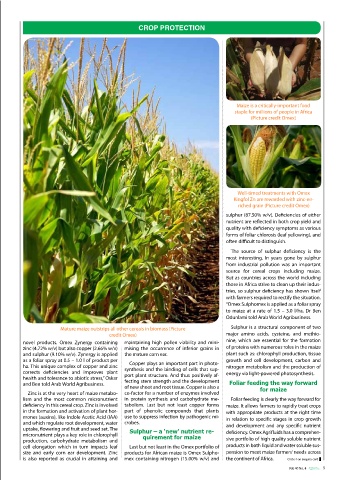
 marine alga (seaweed). “These products are                                         Maize is a critically-important food
 must for maize farmers”, says Oskar.                                              staple for millions of people in Africa
 The beauty of Bio 20 is how it allows maize                                             (Picture credit Omex)
 to  ‘max-out’  in  yield  and  production  even
 when at risk from damage caused by high at-
 Omex Bio 20 and Omex 3X Emulsion give   mospheric  temperatures,  unfavourable  soil
 much needed boosts to maize in the early   conditions  including  moisture  availability
 growth stages (Picture credit Omex)  and disease; and risks that will sound highly
 familiar to maize farmers across Africa. “Afri-
 can maize producers can use either depend-
 ing  upon  the  availability  in  their  country.
 Both are applied as foliar sprays in the early
 vegetative  stages  of  the  crop,”  Oskar  told
 DR TERRY MABBETT  Arab World Agribusiness.
 Maize is the most widely grown cereal sta-
 ple. Maize generates the biggest global ton-  Potassium'–'the'gatekeeper'          Well-timed treatments with Omex
 nage,   highest yield on a per hectare basis   nutrient                           Kingfol Zn are rewarded with zinc-en-
 and the biggest above ground biomass of all   Potassium is required in large amounts for   riched grain (Picture credit Omex)
 the major, mainstream cereal crops.   normal  growth  and  development  and  dur-  sulphur (87.50% w/v). De!ciencies of either
 Maize  is  the  most  widely  grown  crop  in   ing its pivotal role in plant metabolism and   nutrient are re"ected in both crop yield and
 sub-Saharan Africa and a staple food for an   water relations. As such potassium is called   quality with de!ciency symptoms as various
 estimated  50  per  cent  of  the  population.   ‘the gatekeeper’.  Potassium plays an impor-
 Maize  is  grown  the  length  and  breadth  of   tant role in regulating the water content of   forms of foliar chlorosis (leaf yellowing), and
 Africa  and  key  countries  dominating  maize   the  plant  and  with  an  adequate  supply  of   often di#cult to distinguish.
 production in the various regions are: South   potassium plants can survive drought stress   The  source  of  sulphur  de!ciency  is  the
 Africa (17.10 million tonnes - mt) and Malawi   more easily.
 (3.72  mt)  in  Southern  Africa,  Nigeria  (12.74   Potassium is essential for the transport of   most  interesting.  In  years  gone  by  sulphur
 mt) and Ghana (3.40 mt) in West Africa, Ethi-  sugar from the leaves to the storage organs   from  industrial  pollution  was  an  important
 opia  (10.20  mt),  Tanzania  (5.90  mt),  Kenya   where  the  sugar  is  converted  to  starch.  It   source  for  cereal  crops  including  maize.
 (2.90 mt) and Uganda (2.80 mt) in Eastern Af-  plays a major role in maintaining the turgor   But as countries across the world including
 rica and Egypt (7.44 mt) in North Africa  (rigidity) of plant tissue. Leaves need to be   those in Africa strive to clean up their indus-
 Maize  is  a  prime  target  for  foliar  feeding   Maize is the most widely grown cereal   turgid to remain fully extended to maximise   tries, so sulphur de!ciency has shown itself
 with  soluble  nutrients  says  Ben  Odunlami   crop (Picture credit Omex)  the surface exposed to sunlight that provides   with farmers required to rectify the situation.
 (Technical Sales Manager, Africa) and Oskar   ing  from  the  soil  and  into  the  roots  of  the   the energy to convert carbon dioxide in the   “Omex Sulphomex is applied as a foliar spray
 Winkler  (Export  Sales  Manager,  Africa)  at   maize  plant.  Soils  may  be  inherently  de"-  atmosphere  to  sugars  in  the  leaves.  Plants   to  maize  at  a  rate  of  1.5  –  3.0  l/ha,  Dr  Ben
 Omex Agri!uids in the United Kingdom and   cient  in  zinc  or  de"cient  in  plant  available   well  supplied  with  potassium  also  seem  to
 clearly with an eye on African maize produc-  zinc because the micronutrient is locked up   be less susceptible to pest attacks and infec-  Odunlami told Arab World Agribusiness.
 tion which is fast approaching 100 mt.  due  to  speci"c  soil  or  climatic  conditions.   tion by pathogenic fungi.  Mature maize outstrips all other cereals in biomass (Picture   Sulphur is a structural component of two
 Soluble'zinc'as'a'seed'treatment  Zinc  de"ciency  is  aggravated  in  soils  with   “Potassium  is  clearly  major  requirement   credit Omex)  major  amino  acids,  cysteine,  and  methio-
 high  organic  matter,  a  high  pH  (alkaline)   for  fast  growing  maize  crops  and  in  quan-  nine,  which  are  essential  for  the  formation
 Essential  nutrients  in  the  right  amounts   and those rich in phosphorous, which locks   tity,”  says  Ben  Odunlami.  Omex  o#ers  two   novel  products.  Omex  Zynergy  containing   maintaining  high  pollen  viability  and  mini-
 and proportions are, by de"nition a must for   up zinc as insoluble zinc phosphate. Clearly   equivalent  products  –  Omex  K41  (41.00%   zinc (4.72% w/v) but also copper (2.66% w/v)   mising  the  occurrence  of  inferior  grains  in   of proteins with numerous roles in the maize
 all crops including maize although some are   there has to be another way to get zinc into   potassium  w/v)  and  Omex  Sequential  2   and sulphur (9.10% w/v). Zynergy is applied   the mature corn ear.  plant such as: chlorophyll production, tissue
 ‘more  essential  than  others’  depending  on   the maize plant and that avenue is through   (40.00% potassium w/v) and applied as foliar   as a foliar spray at 0.5 – 1.0 l of product per   Copper plays an important part in photo-  growth  and  cell  development,  carbon  and
 the crop.  Zinc is the ‘make or break’ nutri-  the leaves using soluble zinc as a foliar spray.  sprays at, respectively, 3.0 -5.0 l/ha and 2.5   ha. This unique complex of copper and zinc   synthesis and the binding of cells that sup-  nitrogen metabolism and the production of
 ent for maize. Zinc plays a crucial role in ba-  l/ha. Maize growers can use either depend-  corrects  de!ciencies  and  improves  plant   port plant structure. And thus positively af-  energy via light-powered photosynthesis.
 sic plant metabolism and enhances growth,   “Top  of  our  product  list  for  treatment  of   ing upon availability in their country to rest   health and tolerance to abiotic stress,” Oskar
 yield, and the quality of maize grain by stim-  maize  with  zinc  is  Kingfol  Zn  formulated   assured they are furnishing the very high re-  and Ben told Arab World Agribusiness.  fecting stem strength and the development   Foliar'feeding'the'way'forward'
 ulating  chlorophyll  production,  photosyn-  with  the  highest  quality  mineral  elements,   quirement for potassium,” says Ben.  of new shoot and root tissue. Copper is also a   for'maize
 thetic activity, uptake of other nutrients and   marketed as a highly concentrated liquid for-  Zinc is at the very heart of maize metabo-  co-factor for a number of enzymes involved
 protein biosynthesis.  mulation (70% Zn w/v) and in this instance   More'zinc'required  lism  and  the  most  common  micronutrient   in  protein  synthesis  and  carbohydrate  me-  Foliar feeding is clearly the way forward for
 applied  as  a  seed  treatment  @  0.25l/100kg   de!ciency in this cereal crop. Zinc is involved   tabolism.  Last  but  not  least  copper  forms   maize. It allows farmers to rapidly treat crops
 As the ‘make or break’ nutrient for maize,   seed,”  says  Ben.  The  constituents  disperse   In general maize crops ‘cannot get enough   in the formation and activation of plant hor-  part  of  phenolic  compounds  that  plants
 zinc is required throughout the entire period   easily  with  no  requirement  for  pre-mixing   zinc’.  Oskar  and  Ben  told  Arab  World  Agri-  mones (auxins), like Indole Acetic Acid (IAA)   use to suppress infection by pathogenic mi-  with  appropriate  products  at  the  right  time
 of crop growth to ensure the harvest of zinc-  and ideal for correcting a speci"c zinc de"-  business how zinc has gone foliar in applica-  and which regulate root development, water   crobes.  in relation to speci!c stages in crop growth
 enriched  grain.  Zinc  enrichment  of  maize   ciency.   tion to growing maize crops, so I asked them   uptake, "owering and fruit and seed set. The   and  development  and  any  speci!c  nutrient
 grain is a growing global challenge to ensure   what Omex had to o#er African maize grow-  micronutrient plays a key role in chlorophyll   Sulphur'–'a'‘new’'nutrient're1  de!ciency. Omex Agri"uids has a comprehen-
 the health and well-being of human popula-  Bio'boost'for'maize'seedlings  ers to satisfy this high requirement for zinc   production,  carbohydrate  metabolism  and   quirement'for'maize  sive portfolio of high quality soluble nutrient
 tions who rely on maize as the main staple.   during the active growth stages of the crop.   products in both liquid and water soluble sus-
 Many African countries fall into this category.   “Targeted at the seedling stage is a pair of   cell  elongation  which  in  turn  impacts  leaf   Last but not least in the Omex portfolio of
 products that boost maize seedling growth   “This high and essential requirement can   size  and  early  corn  ear  development.  Zinc   products for African maize is Omex Sulpho-  pension to meet maize farmers’ needs across
 There are major constraints on zinc mov-  and establishment”, said Oskar Winkler. They   be provided by one of our newest and most   is  also  reported  as  crucial  in  attaining  and   mex  containing  nitrogen (15.00%  w/v) and   the continent of Africa.  Circle 4 on enquiry card
  4      Vol. 40 No. 4                                                                                 Vol. 40 No. 4   5

