


Page 24 - Vol.39-No.5
P. 24
HARVESTING AND STORAGE

               INCLUSION THROUGH AGRICULTURE FOR

                                    REFUGEES IN UGANDA


                                              In that light, the Food and Agriculture  market, keeping money aside for emergen-
                                            Organization of the United Nations (FAO)  cies and using the rest to feed her children.
                                            invests in self-reliance for the benefit of   “I realize that the skills I have gained
                                            everyone – from the country and com-  have changed my life,” says Betty. She
                                            munities that host refugees, who are often   even shares these new skills with others
                                            themselves food insecure, to the refugees,   in the settlement: “Many others come to
                                            who can build skills to support their live-  learn from me.”
                                            lihoods in their place of displacement or
                                            back home, should it become safe to re-  The passion fruit crop has proven popular
          When Betty Ocira Acayo arrived in   turn there.                       in the local market, and if in the future the
                                                                                new farmers scale up production, FAO will
        northern Uganda with her five children,   Betty was invited to join FAO’s Refugee   be able to connect them to larger buyers
        her first concern was where she and her  Agricultural Value Chains for Economic   from the capital who can buy the fruit in
        family would live – followed closely by how  Self Reliance project. Funded by the IKEA   bulk. This will further increase the sustain-
        she would feed them.                Foundation, the project’s goal is to build   ability of the passion fruit value chain in
          Betty’s family crossed the border in   sustainable livelihoods for both refugees   Uganda and improve the economic out-
        2016, alongside over 500 000 other peo-  living in the Kiryandongo settlement and   comes for farmers.
        ple, mostly women and children, fleeing   Ugandans living in the neighboring com-
        violent conflict in South Sudan. The Gov-  munities around it.
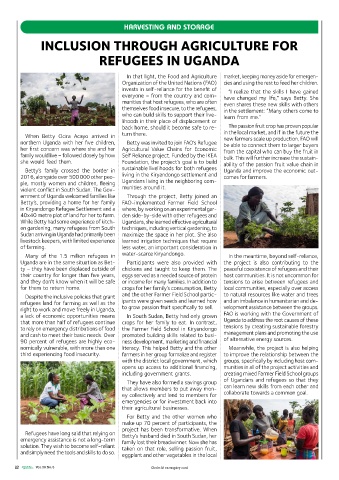
        ernment of Uganda welcomed families like   Through the project, Betty joined an
        Betty’s, providing a home for her family  FAO-implemented Farmer  Field School
        in Kiryandongo Refugee Settlement and a  where, by working on an experimental gar-
        40x40 metre plot of land for her to farm.  den side-by-side with other refugees and
        While Betty had some experience of kitch-  Ugandans, she learned effective agricultural
        en gardening, many refugees from South  techniques, including vertical gardening, to
        Sudan arriving in Uganda had primarily been  maximize the space in her plot. She also
        livestock keepers, with limited experience  learned irrigation techniques that require
        of farming.                         less water, an important consideration in
          Many of the 1.5 million refugees in   water-scarce Kiryandongo.        In the meantime, beyond self-reliance,
        Uganda are in the same situation as Bet-  Participants were also provided with  the project is also contributing to the
        ty – they have been displaced outside of  chickens and taught to keep them. The  peaceful coexistence of refugees and their
        their country for longer than five years,  eggs served as a needed source of protein  host communities. It is not uncommon for
        and they don’t know when it will be safe  or income for many families. In addition to  tensions to arise between refugees and
        for them to return home.            crops for her family’s consumption, Betty  local communities, especially over access
          Despite the inclusive policies that grant   and the other Farmer Field School partic-  to natural resources like water and trees
        refugees land for farming as well as the   ipants were given seeds and learned how  and an imbalance in humanitarian and de-
        right to work and move freely in Uganda,   to grow passion fruit specifically to sell.   velopment assistance between the groups.
        a lack of economic opportunities means   In South Sudan, Betty had only grown   FAO is working with the Government of
        that more than half of refugees continue  crops for her family to eat. In contrast,   Uganda to address the root causes of these
        to rely on emergency distributions of food  the Farmer Field School in Kiryandongo   tensions by creating sustainable forestry
        and cash to meet their basic needs. Over  promoted building skills related to busi-  management plans and promoting the use
        90 percent of refugees are highly eco-  ness development, marketing and financial   of alternative energy sources.
        nomically vulnerable, with more than one  literacy. This helped Betty and the other   Meanwhile, the project is also helping
        third experiencing food insecurity.   farmers in her group formalize and register  to improve the relationship between the
                                            with the district local government, which  groups, specifically by including host com-
                                            opens up access to additional financing,  munities in all of the project activities and
                                            including government grants.        creating mixed Farmer Field School groups
                                                                                of Ugandans and refugees so that they
                                              They have also formed a savings group
                                            that allows members to put away mon-  can learn new skills from each other and
                                            ey collectively and lend to members for   collaborate towards a common goal.
                                            emergencies or for investment back into
                                            their agricultural businesses.
                                              For Betty and the other women who
                                            make up 70 percent of participants, the
                                            project has been transformative. When
          Refugees have long said that relying on   Betty’s husband died in South Sudan, her
        emergency assistance is not a long-term   family lost their breadwinner. Now she has
        solution. They wish to become self-reliant   taken on that role, selling passion fruit,
        and simply need the tools and skills to do so.  eggplant and other vegetables in the local

      22         Vol. 39 No. 5                        Circle 29 on enquiry card

