


Page 50 - AA 2026
P. 50
Yemen


       Harvesting of 2026 winter wheat and planting


       of sorghum crops nearing completion

        Agricultural activities  for the 2026                                 sight stabilized the Yemeni rial at an
       season are progressing under gener-                                    average of YER 1 553/USD 1 in April
       ally  favourable weather conditions,                                   2026, representing a 55 percent year
       although  weather  conditions have                                     on year appreciation. This exchange
       been  mixed  with  intensified  rainfall                               rate stability kept staple food prices
       that triggered flash floods across                                     unchanged month on month and 22 to
       southwestern parts of the country,                                     30 percent lower than in April 2025.
       with considerable impacts on com-                                      In Hadramout Governorate, wheat
       munities and farmlands.  Harvesting                                    flour prices reached a record high
       of the 2026 winter wheat finalized in                                  of about YER 1 300/kg in July 2025
       April in the eastern Plateau and is still                              before declining sharply in August,
       underway in the  northern  and cen-                                    mainly reflecting the appreciation of
       tral highlands, where above average                                    the Aden  based Yemeni rial,  which
       rainfall amounts in March supported                                    strengthened from an average of YER
       crop development and vegetation                                        2 800/USD 1 in July to  about  YER 1
       conditions, pointing to near-average   at a near average level of 5.2 million   660/USD 1 in early August following
       production prospects. Planting of the   tonnes. The country remains highly   exchange rate stabilization measures
       2026 main rainfed sorghum crop has   dependent  on imports  to  meet  its   in the government controlled areas.
       been completed in most highland    domestic consumption needs, as lim-   However,  deteriorating  economic
       areas, including the northern, cen-  ited local production and protracted   conditions  continue to drive acute
       tral highlands and southern uplands,   conflict continue to  constrain local   food insecurity across the country. In
       while sowing activities are still ongo-  supply.  According to the latest Ye-  the GoY, staple food prices increased
       ing in some coastal areas. Although   men Food Security Update , food im-  month on month in March 2026 due to
       favourable seasonal rainfall between   ports through the Red Sea remained   higher insurance and transport costs
       March and April 2026 generally sup-  at adequate levels as of March 2026,   linked to the conflict in the Middle
       ported crop establishment and early   with cumulative import volumes dur-  East, fuel price increases and foreign
       development,  below  average  pre-  ing the first quarter of 2026 at about   currency shortages. In Sana’a Based
       cipitation  amounts are forecast in   28 percent above the same period in   Authorities  controlled areas, addi-
       parts of the southern uplands and   2025. This increase was largely sup-  tional  taxation  in  early  2026  further
       northern areas, which may constrain   ported by commercial wheat imports,   raised prices of staple foods, reduc-
       crop development in the affected ar-  the main staple commodity used for   ing households’ purchasing power.
       eas. Furthermore, farmers continue   bread production. However, the re-  Ongoing  localized  conflicts, supply
       to face constraints in accessing agri-  cent escalation of regional conflicts   disruptions  and currency deprecia-
       cultural inputs, particularly fertilizers   has increased shipping and cereal   tion continue to constrain food access
       and fuel, due to high prices, amid the   costs, amid foreign exchange short-  and disrupt markets and livelihoods.
       conflict in the Middle East that started   ages.  In March 2026, no fuel was   According  to  the  2026 Humanitar-
       in late February 2026.             imported  through the  Red  Sea  ports   ian Needs and Response Plan (HNRP)
                                          and fuel imports through  the South-
        Below-average  cereal  production   ern route fell by about  60 percent   , about  18.3 million people nation-
       estimated in 2025                  below average. Fuel prices rose 11   wide  were projected  to face high
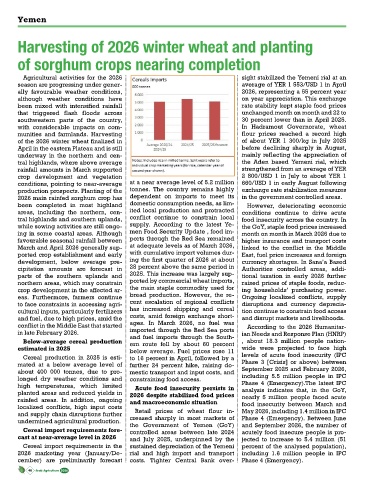
        Cereal  production in  2025  is  esti-  to 16 percent in April, followed by a   levels of  acute  food  insecurity  (IPC
       mated  at  a below  average  level of   further  24 percent  hike,  raising  do-  Phase 3 [Crisis] or above) between
       about  400 000 tonnes, due to pro-  mestic transport and input costs, and   September 2025 and February 2026,
       longed dry weather conditions  and   constraining food access.         including 5.5  million people in IPC
       high  temperatures, which limited    Acute food insecurity persists in   Phase 4 (Emergency).The latest IPC
       planted areas and reduced yields in   2026 despite stabilized food prices   analysis indicates that, in  the GoY,
       rainfed areas. In  addition,  ongoing   and macroeconomic situation    nearly 5 million people faced  acute
       localized conflicts, high input costs                                  food  insecurity between  March and
       and supply chain disruptions further   Retail prices of wheat flour in-  May 2026, including 1.4 million in IPC
       undermined agricultural production.  creased sharply  in most markets of   Phase 4 (Emergency). Between June
                                          the Government of Yemen (GoY)
                                                                              and September 2026, the number of
        Cereal import requirements fore-  controlled areas between  late 2024   acutely food insecure people is pro-
       cast at near-average level in 2026  and July 2025, underpinned by the   jected to increase to 5.4  million (51
        Cereal  import requirements in  the   sustained depreciation of the Yemeni   percent of the analysed population),
       2026 marketing year (January/De-   rial and high import and transport   including 1.6  million people in IPC
       cember) are preliminarily forecast   costs. Tighter  Central Bank over-  Phase 4 (Emergency).
          48    Arab Agriculture  2026

