


Page 6 - AWA_No_7 A & E copy.indd
P. 6
CROP PROTECTION
                     Blackcurrants are one of the new super fruits

                                              Nowhere is this more so true than in the
                                             United  Kingdom  (UK).  Blackcurrant  has
                                             always  had  prime  place  in  British  culture
                                             and cuisine, traditionally treasured for un-
                                             rivalled  vitamin  C  (ascorbic  acid)  content
                                             and more recently elevated to ‘super-fruit’
                                             status. Ribes nigra is one the tiniest com-
                                             mercially-grown fruit but packs one of the
                                             biggest punches for health giving proper-
                                             ties. Hugely rich in antioxidants and nota-
                                             bly anthocyanins, which impart unrivalled
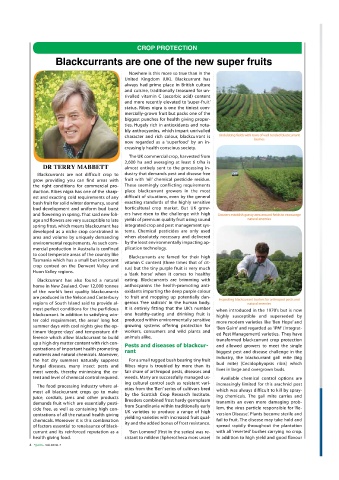
                                             character  and  rich  colour,  blackcurrant  is   Undulating !elds with rows of well tended blackcurrant
                                                                                          bushes
                                             now  regarded  as  a  ‘superfood’  by  an  in-
                                             creasingly health conscious society.
                                              The UK commercial crop, harvested from
                                             2,600  ha  and  averaging  at  least  6  t/ha  is
                DR TERRY MABBETT             almost  entirely  sent to  the  processing in-
              Blackcurrants  are  not  difficult  crop  to   dustry that demands pest and disease free
             grow  providing  you  can  find  areas  with   fruit  with ‘nil’  chemical  pesticide  residue.
             the  right  conditions  for  commercial  pro-  These seemingly conflicting requirements
             duction. Ribes nigra has one of the sharp-  place  blackcurrant  growers  in  the  most
             est and exacting cold requirements of any   difficult of situations, even by the general
             bush fruit for solid winter dormancy, sound   exacting standards of the highly sensitive
             bud development and uniform bud burst   horticultural  crop  market.  But  UK  grow-
             and flowering in spring. That said new foli-  ers have risen to the challenge with high   Growers establish grassy area around !elds to encourage
             age and flowers are very susceptible to late   yields of premium quality fruit using sound   natural enemies
             spring frost, which means blackcurrant has   integrated crop and pest management sys-
             developed as a niche crop constrained in   tems.  Chemical  pesticides  are  only  used
             area and  volume by  uniquely  demanding   when  absolutely  necessary  and  delivered
             environmental requirements. As such com-  by the least environmentally impacting ap-
             mercial production in Australia is confined   plication technology.
             to cool temperate areas of the country like   Blackcurrants  are  famed  for  their  high
             Tasmania which has a small but important   vitamin C content (three times that of cit-
             crop  centred  on  the  Derwent  Valley  and   rus) but the tiny purple fruit is very much
             Huon Valley regions.            a  ‘dark  horse’  when  it  comes  to  healthy
              Blackcurrant  has  also  found  a  natural   eating.  Blackcurrants  are  brimming  with
             home in New Zealand. Over 12,000 tonnes   anthocyanins  the  health-promoting  anti-
             of  the  world’s  best  quality  blackcurrants   oxidants imparting the deep purple colour
             are produced in the Nelson and Canterbury   to  fruit  and  mopping  up  potentially  dan-  Inspecting blackcurrant bushes for arthropod pests and
             regions of South Island said to provide al-  gerous ‘free  radicals’  in  the  human  body.   natural enemies
             most perfect conditions for the perfidious   It  is  entirely  fitting  that  the  UK’s  number   when introduced in the 1970’s but is now
             blackcurrant. In addition to satisfying win-  one  healthy-eating  and  drinking  fruit  is   highly  susceptible  and  superseded  by
             ter  cold  requirement,  the  areas’  long  hot   produced within environmentally sensitive   more modern varieties like ‘Ben Hope’ and
             summer days with cool nights give the op-  growing  systems  offering  protection  for   ‘Ben Gairn’ and regarded as ‘IPM’ (Integrat-
             timum ‘degree-days’ and temperature dif-  workers,  consumers  and  wild  plants  and   ed Pest Management) varieties.  They have
             ference which allow blackcurrant to build   animals alike.      transformed  blackcurrant  crop  protection
             up a high dry matter content with rich con-  Pests%and%diseases%of%blackcur2  and  allowed  growers  to  meet  the  single
             centrations of important health promoting   rant                biggest pest and disease challenge in the
             nutrients and natural chemicals. Moreover,                      industry,  the  blackcurrant  gall  mite  (big
             the  hot  dry  summers  naturally  suppress   For a small rugged bush bearing tiny fruit   bud  mite)  [Cecidophyopsis  ribis]  which
             fungal  diseases,  many  insect  pests  and   Ribes  nigra  is  troubled  by  more  than  its
             most  weeds,  thereby  minimising  the  ex-  fair share of arthropod pests, diseases and   lives in large and overgrown buds.
             tent and level of chemical control required.   weeds. Many are successfully managed us-  Available  chemical  control  options  are
                                             ing cultural control such as resistant vari-
              The  food  processing  industry  where  al-  eties from the ‘Ben’ series of cultivars bred   increasingly limited for this arachnid pest
             most  all  blackcurrant  crops  go  to  make   by  the  Scottish  Crop  Research  Institute.   which was always difficult to kill by spray-
             juice,  cordials,  jams  and  other  products   Breeders combined frost hardy germplasm   ing  chemicals.  The  gall  mite  carries  and
             demands fruit which are essentially pesti-  from Scandinavia within traditionally early   transmits  an  even  more  damaging  prob-
             cide  free,  as  well  as  containing  high  con-  UK  varieties  to  produce  a  range  of  high   lem, the virus particle responsible for ‘Re-
             centrations of all the natural health giving   yielding varieties with increased fruit qual-  version Disease’. Plants become sterile and
             chemicals. Moreover it is this combination   ity and the added bonus of frost resistance.   fail to fruit. The disease may take hold and
             of factors essential to renaissance of black-                   spread  rapidly  throughout  the  plantation
             currant  and  its  reinforced  reputation  as  a   ‘Ben Lomond’ (first in the series) was re-  with all ‘reverted’ bushes carrying no crop.
             health giving food.             sistant to mildew (Spherotheca mors uvae)   In addition to high yield and good flavour
            4      Vol. 40 No. 7

