


Page 15 - Vol.39-No.9 issue
P. 15
FOOD PROCESSING

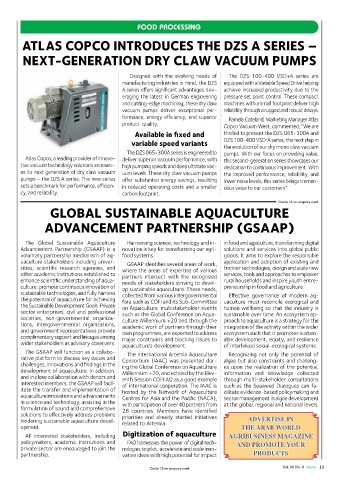
         ATLAS COPCO INTRODUCES THE DZS A SERIES –

         NEXT-GENERATION DRY CLAW VACUUM PUMPS


                                                Designed  with  the  evolving  needs  of   The  DZS  100-400  VSD+A  series  are
                                            manufacturing industries in mind, the DZS  equipped with a Variable Speed Drive helping
                                            A series o!ers significant advantages. Lev-  achieve increased productivity due to the
                                            eraging the latest in German engineering  pressure set point control. These compact
                                            and cutting-edge machining, these dry claw  machines with a small footprint deliver high
                                            vacuum  pumps  deliver  exceptional  per-  reliability through a rugged and robust design.
                                            formance, energy e#ciency, and superior   Pamela Cateland, Marketing Manager Atlas
                                            product  quality.
                                                                                Copco Vacuum West, commented, “We are
                                                Available in fixed and           thrilled to present the DZS 065-300A and
                                                                                              +
                                               variable speed variants          DZS 100-400 VSD A series, the next step in
                                                                                the evolution of our dry mono claw vacuum
                                              The DZS 065-300A series is engineered to  pumps. With our focus on providing value,
          Atlas Copco, a leading provider of innova-  deliver superior vacuum performance, with  this second-generation series showcases our
        tive vacuum technology solutions announc-  high pumping speeds and deep ultimate vac-  dedication to continuous improvement. With
        es its next generation of dry claw vacuum  uum levels. These dry claw vacuum pumps  the improved performance, reliability, and
        pumps – the DZS A series. This new series  o!er substantial energy savings, resulting  lower noise levels, this series brings tremen-
        sets a benchmark for performance, e#cien-  in  reduced  operating  costs  and  a  smaller  dous value to our customers”.
        cy, and reliability.                carbon footprint.
                                                                                                   Circle 18 on enquiry card
                   GLOBAL SUSTAINABLE AQUACULTURE

                 ADVANCEMENT PARTNERSHIP (GSAAP)


          The  Global  Sustainable  Aquaculture   Harnessing science, technology and in-  in food and agriculture, transforming digital
        Advancement  Partnership  (GSAAP)  is  a  novation is key for transforming our agri-  solutions and services into global public
        voluntary partnership mechanism of aq-  food systems.                   goods. It aims to explore the responsible
        uaculture stakeholders including univer-  GSAAP identifies several areas of work,   application and adoption of existing and
        sities,  scientific  research  agencies,  and   where the areas of expertise of various   frontier technologies, design and scale new
        other academic institutions established to   partners  intersect  with  the  recognized   services, tools and approaches to empower
        enhance scientific understanding of aqua-  needs of stakeholders striving to devel-  rural households and inspire youth entre-
        culture, promote continuous innovation of   op sustainable aquaculture. These needs,   preneurship in food and agriculture.
        sustainable technologies, and fully harness   collected from various intergovernmental   E!ective  governance  of  modern  aq-
        the potential of aquaculture for achieving   fora such as COFI and its Sub-Committee  uaculture  must  reconcile  ecological  and
        the Sustainable Development Goals. Private   on Aquaculture, multistakeholder events  human wellbeing so that the industry is
        sector enterprises, civil and professional   such as the Global Conference on Aqua-  sustainable over time. An ecosystem ap-
        societies,  non-governmental  organiza-  culture Millennium +20 and through the  proach to aquaculture is a strategy for the
        tions,  intergovernmental  organizations,   academic work of partners through their  integration of the activity within the wider
        and government representatives provide   own programmes, are expected to address  ecosystem such that it promotes sustain-
        complimentary support and linkages among   major constraints and blocking issues to  able development, equity, and resilience
        wider stakeholders as advisory observers.   aquaculture’s development.  of interlinked social-ecological systems.
          The GSAAP will function as a collabo-  The International Artemia Aquaculture   Recognizing  not  only  the  potential  of
        rative platform to discuss key issues and   Consortium (IAAC) was presented dur-  algae but also constraints and challeng-
        challenges, innovations and findings in the   ing the Global Conference on Aquaculture  es upon the realization of the potential,
        development of aquaculture. In addition,   Millennium +20, and echoed by the Elev-  information  and  knowledge  collected
        and in close collaboration with donors and   enth Session COFI:AQ as a good example  through multi-stakeholder consultations
        interested members, the GSAAP will facil-  of international cooperation. The IAAC is  such as the Seaweed Dialogues can fa-
        itate the transfer and implementation of   hosted  by  the  Network  of  Aquaculture  cilitate evidence-based policymaking and
        aquaculture innovations and advancements   Centres for Asia and the Pacific (NACA),  sector management in algae development
        in science and technology, assisting in the   with participation of over 40 partners from  at the global, regional and national levels.
        formulation of sound and comprehensive   28  countries.  Members  have  identified
        solutions to e!ectively address problems   priorities  and  already  started  initiatives
                                                                                        ADVERTISE IN
        hindering sustainable aquaculture devel-  related to Artemia.                   ADVERTISE IN
        opment.                                                                       THE ARAB WORLD
                                                                                      THE ARAB WORLD
                                                                                 AGRIBUSINESS MAGAZINE
          All  interested  stakeholders,  including   Digitization of aquaculture  AGRIBUSINESS MAGAZINE
        policymakers, academic institutions and   FAO harnesses the power of digital tech-  AND PROMOTE YOUR
                                                                                    AND PROMOTE YOUR
        private sector are encouraged to join the  nologies to pilot, accelerate and scale inno-
                                                                                          PRODUCTS
        partnership.                        vative ideas with high potential for impact   PRODUCTS
                                                                                                    Vol. 39 No. 9   13
                                                      Circle 19 on enquiry card

