


Page 23 - AA 2026
P. 23
Iraq


          taining  Iraq’s agricultural  systems.   Early‑season dry weather conditions hampered
          Through our collaboration with FAO
          and partners, we are addressing ur-  cereal planting operations
          gent needs while advancing national
          efforts toward resilience and sustain-
          able agricultural development.”
           Within this broader  national ef-
          fort, the initiative also contributes to
          United Nations support to Iraq in ad-
          dressing climate change impacts and
          protecting vulnerable populations.
           It further aligns with the United
          Nations Sustainable Development
          Cooperation  Framework (UNSDCF)
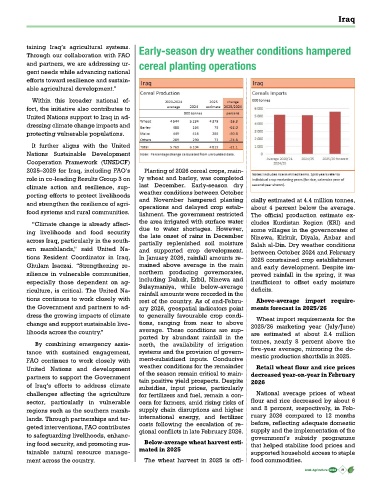
          2025–2029 for Iraq, including FAO’s   Planting of 2026 cereal crops, main-
          role in co-leading Results Group 3 on   ly wheat and barley, was completed
          climate  action and resilience,  sup-  last December. Early-season dry
          porting efforts to protect livelihoods   weather conditions between October
          and strengthen the resilience of agri-  and November hampered planting   cially estimated at 4.4 million tonnes,
                                             operations and delayed crop estab-
                                                                                 about 4 percent below the average.
          food systems and rural communities.  lishment. The government restricted   The  official  production  estimate  ex-
           “Climate change is already affect-  the area irrigated with surface water   cludes Kurdistan Region (KRI) and
          ing livelihoods  and food security   due to water shortages. However,   some villages in the governorates of
                                             the late onset of rains in December
          across Iraq, particularly in the south-  partially replenished soil moisture   Ninewa, Kirkuk, Diyala, Anbar and
          ern marshlands,” said United Na-   and supported crop development.     Salah al-Din. Dry weather conditions
                                                                                 between October 2024 and February
          tions Resident Coordinator in  Iraq,   In January 2026, rainfall amounts re-  2025 constrained crop establishment
          Ghulam  Isaczai. “Strengthening re-  mained  above  average  in  the  main   and early development. Despite im-
          silience in vulnerable  communities,   northern producing governorates,   proved rainfall in the spring, it was
          especially those dependent on ag-  including Dahuk, Erbil, Ninewa and   insufficient  to  offset  early  moisture
                                             Sulaymaniya,  while  below-average
          riculture, is critical. The United  Na-  rainfall amounts were recorded in the   deficits.
          tions continues to work closely with   rest of the country. As of end-Febru-  Above-average import require-
          the Government and partners to ad-  ary 2026, geospatial indicators point   ments forecast in 2025/26
          dress the growing impacts of climate   to generally favourable crop condi-  Wheat import requirements for the
          change and support sustainable live-  tions,  ranging  from  near  to  above   2025/26 marketing year (July/June)
          lihoods across the country.”       average. These conditions are sup-  are estimated at about 2.4 million
                                             ported by abundant rainfall in the
            By combining  emergency assis-   north, the availability of irrigation   tonnes, nearly 8 percent above the
          tance with  sustained  engagement,   systems and the provision of govern-  five-year average, mirroring the do-
                                                                                 mestic production shortfalls in 2025.
          FAO continues to  work closely with   ment-subsidized inputs. Conducive
          United  Nations and development    weather conditions for the remainder   Retail wheat flour and rice prices
          partners to support the Government   of the season remain critical to main-  decreased year-on-year in February
                                             tain positive yield prospects. Despite
          of Iraq’s efforts to address climate   subsidies,  input  prices,  particularly   2026
          challenges affecting the agriculture   for fertilizers and fuel, remain a con-  National average prices of wheat
          sector, particularly  in vulnerable   cern for farmers, amid rising risks of   flour and rice decreased by about 6
          regions such as the southern marsh-  supply  chain  disruptions  and  higher   and 8 percent, respectively, in Feb-
          lands. Through partnerships and tar-  international energy, and fertilizer   ruary  2026 compared to 12 months
          geted interventions, FAO contributes   costs following the escalation of re-  before, reflecting adequate domestic
                                                                                 supply and the implementation of the
                                             gional conflicts in late February 2026.
          to safeguarding livelihoods, enhanc-                                   government’s subsidy programme
          ing food security, and promoting sus-  Below-average wheat harvest esti-  that helped stabilize food prices and
          tainable natural resource manage-  mated in 2025                       supported household access to staple
          ment across the country.             The  wheat  harvest  in  2025  is  offi-  food commodities.
                                                                                                  Arab Agriculture  2026  21

